
Combining these two practices can create more impactful climate projects
by Jason Grillo

At the project level, biochar can simultaneously sequester carbon and reduce methane and nitrous oxide. When two rapidly expanding adjacent sectors get big enough, odds are that the scope of their activities are going to overlap. In the field of climate projects, biochar (a rapidly expanding category) and superpollutants (another rapidly expanding category) are going to have points of intersection.
I’m going to outline areas where I have observed this intersection, and what can be done to advance this. In a (carbon negative) nutshell:
- Scientific evidence suggests that biochar can reduce super pollutant emissions, particularly methane (CH4) and nitrous oxide (N2O) in specific industrial applications.
- Biochar use-cases can lead to emissions reductions of super pollutants in addition to representing a store of CO2 for durable carbon removal.
- Credit stacking through methodologies are starting to take shape – or if not, they should – about this trend.
- In cases where offsets are not an option, achieving operational compliance with existing (or future) regulations is an opportunity for corporations to take action.
I’m writing this with project developers, carbon credit intermediaries, landfill operators or farmers, registries, and regulators in mind: there is opportunity here for advancing impactful climate solutions along several dimensions.
With that, on to some examples
First, biochar in landfills.
We know that landfill methane emissions are a problem – many regulations are on the books for landfill operators to comply with (more on that later), while landfill gas capture projects have been around for a long time, using an active system of vertical wells and/or horizontal trenches drilled into the waste.
Enter biochar. The premise is that placing biochar into landfills not only enables the carbon dioxide represented in the char to be stored durably, but also that the biochar reduces methane emissions When incorporated into landfill cover soil, biochar can promote methanotrophic bacteria, which oxidize methane before it escapes into the atmosphere, as noted in a 2020 study.
Credit where it’s due: some of this has been covered by Jigar Shah already when discussing biochar startup Carba, whose physical biochar product from its first facility in Minnesota is destined for landfills. Other co-benefits follow such as reducing PFAS leaching at landfills and preventing odors from organic waste decomposing.
Research has been ongoing for over a decade on biochar reducing landfill methane. And not just in Minnesota but in Miami-Dade County as well, with other research funded by the National Science Foundation providing further support.
For regulatory compliance, Municipal Solid Waste (MSW) landfills are required by the EPA to monitor carbon dioxide and methane – and were not adequately doing so in a September 2024 report. That said, with the lapse of EPA’s endangerment finding, regulating methane will likely fall to states.
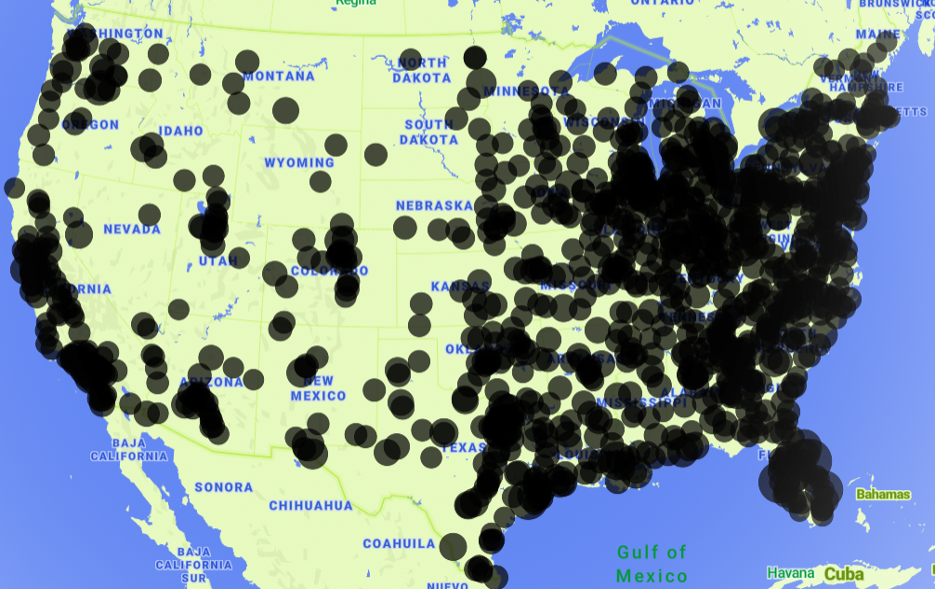
In jurisdictions where GHGs from landfills are not regulated, the door to carbon dioxide sequestration and methane avoidance crediting is open, provided that adequate monitoring technologies are present onsite, which is where a biochar use case can yield credits for the Voluntary Carbon Market (VCM).
Outside the United States, other jurisdictions require landfill monitoring of GHGs as well, and have strong regulations. In these cases, landfill operators can add biochar to improve their ability to be in compliance with regulations for carbon dioxide and methane.
Also, high praise for Google and AMP on their new partnership to pre-sort organic waste that would have otherwise gone into a landfill, then using that as biochar feedstock. Truly an ingenious pairing – and utilizing that biochar in a landfill itself or for other superpollutant mitigation would be even more amazing!
Second, biochar as manure compost additive
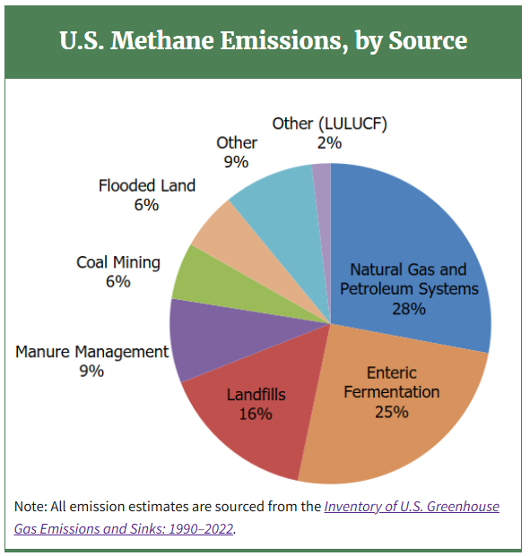
Agriculture – including livestock – represents a major component of methane emissions. And manure based methane totals 9% of all US methane emissions – for comparison the entire oil and natural gas sector has about 28%.
The narrative is set up like this:
- Farmers create compost from their own livestock to till into their fields.
- Adding biochar to this compost reduces methane emissions.
- Registries are starting to take notice (1), with CAR in particular offering an opening for future superpollutant mitigation through biochar application.
Once methodologies for combining biochar with manure compost are developed, a new revenue stream would open up for biochar projects. One caveat is that evidence suggests that the source of the compost matters: the non-GHG story story is less clear for yard waste or green waste based compost, compared to livestock manure compost.
Dairy farmers especially in California are already regulated in the amount of methane that they can emit; again biochar would offer a path to compliance. California dairy farmers in particular are subject to AB 1383 which mandates methane emissions reduction by 2030. In this way, biochar would enhance their ability to achieve regulatory compliance.
In this case the biochar producer can rely on the familiar narrative of biochar’s agricultural benefits of water retention, crop yields, and nitrification reduction, as shown in recent work by the University of California at Merced. Furthermore, adding biochar to manure compost can reduce compost nitrous oxide emissions – noting that nitrous oxide has a residency time of approximately 300 years in the atmosphere and has a Global Warming Potential (GWP) 273 times that of CO2 on a 100 year timescale.
Third, biochar with anaerobic digestion
Here’s where the biochar and superpollutant story adds a twist: instead of combining the biochar into manure to place directly on fields, add it to an anaerobic digester (AD) that produces natural gas for sale.
Why? Science has shown (here, here, and here for starters), that adding biochar to anaerobic digesters (AD) not only increases natural gas output, but also increases the quality of the resulting biogas by reducing its sulfur content. The digestate product from the AD is higher quality with biochar than without, and can be used on fields as above.
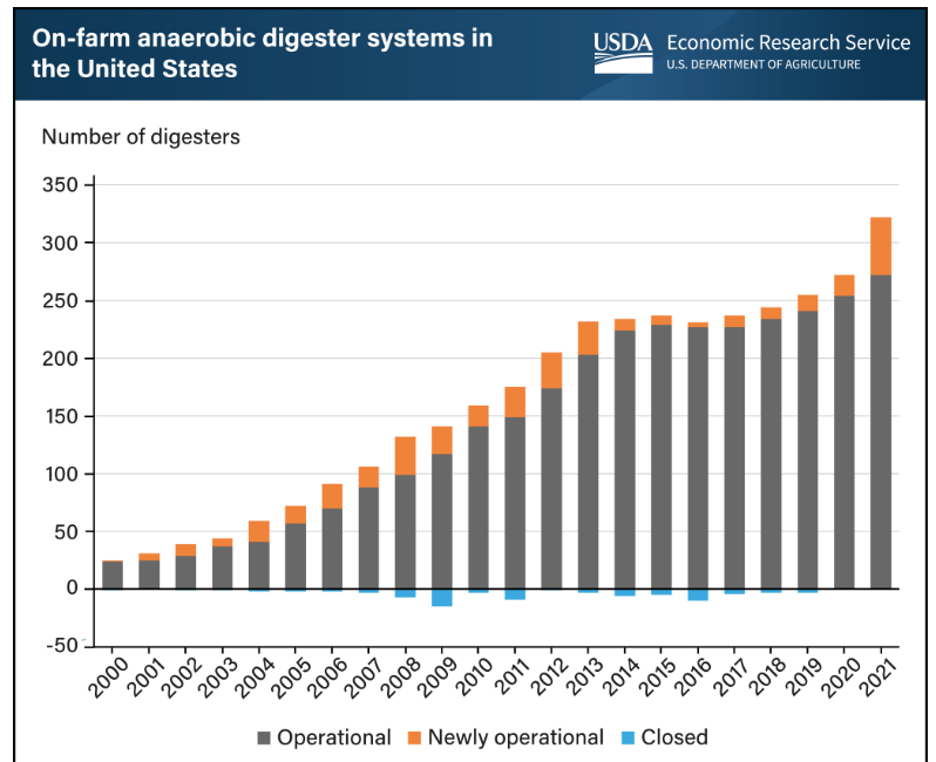
Furthermore the AD operator can sell more higher quality energy than they could otherwise. In certain jurisdictions (CA, WA, OR, BC), a Low Carbon Fuel Standard (LCFS) credit improves the revenue from biogas production. In the geopolitical situation at the time of this writing in March 2026, rising prices for natural gas also could make more of these operations economically viable, particularly in Europe and Asia.
In the case of AD whose biogas feeds electricity generation, producing more energy locally reduces transmission and distribution cost burden on rural energy systems. Using locally produced biochar also would reduce transportation emissions for the biochar producer, improving their lifecycle assessments for carbon removal crediting purposes. And the additional biogas revenue, especially when combined with Low Carbon Fuel Standard (LCFS) incentives, can improve the economics of anaerobic digestion.
Farmers get: digestate with biochar to place on their fields.
Anaerobic digester operators get: more natural gas to sell
Biochar producers get: A customer for their physical product.
Finally, beyond ADs for animal manure, wastewater sludge treatment in an AD using biochar as a filtration mechanism yields similar biogas quantity and quality improvements. Knowing that biochar is already being considered a filtration medium for wastewater, this would combine nicely if biochar companies were to partner with wastewater management facilities to improve the methane footprint.
Crediting Challenges
As with other crediting pathways, these projects need to clear both regulatory additionality and financial additionality thresholds in order to create carbon credits. This might mean that crediting would not be possible in jurisdictions that already have statutes in place for livestock manure or landfill methane. However the benefits due to CO2 sequestration credits would still be valid, making the project itself economically viable with a ready-made use case for selling the physical biochar product.
For financial additionality, a project would have to consult its registry to better understand the IRR threshold necessary for creating more credits for the project. In that vein, more projects that are not economically viable today could benefit if investors see the increased potential for return due to a stacked methane or nitrous oxide credit.
Operational Challenges
Anaerobic digesters in particular face a complex permitting pathway, with project developers navigating a patchwork of national, subnational, and local regulations. Local opposition may also arise due to environmental concerns such as odors from the AD facility, or its effect on water supply. Zoning challenges may also hold AD projects in check due to proximity to schools, homes, or other sensitive locations.
For landfill biochar, operating dynamics are a hurdle. Similar to anaerobic digesters, there is a high degree of variability to the regulations affecting landfills. Biochar producers may have to prove out the ability of their particular biochar from a single feedstock to win approval from the landfill management company or local government.
How To Move Forward
What is a biochar operator to do?
Well for one thing, start engaging with registries who can adequately credit the carbon removal credit from placing biochar into landfills, ensure that it can combine with compost and still get a credit, and create a protocol that ensures that the CO2 is still sequestered in the digestate from an anaerobic digester. The science is out there! Regardless of the super pollutant emissions profile of the landfill, compost, or anaerobic digester project, a biochar producer will need verification that the char is still sequestered.
Second, find landfill or manure composters who have good monitoring systems for the methane and nitrous oxide. If technically feasible and economically viable, work to create methane reduction or nitrous oxide reduction credits to support these operations.
Third, look to anaerobic digesters in your area, especially if you operate where an LCFS is in effect. Even if the biochar volume is low as a pilot, expansion potential in the future for biochar sales would be an important signal.
Conclusions
Over the next 2 to 3 years, carbon market stakeholders, project developers, and service providers should develop the additional benefits of biochar via superpollutant mitigation. Economic and operational reasons need to undergird integrating these projects into an existing industrial ecosystem. Adding regulatory compliance, improved economics or additional carbon crediting incentives to the mix can speed deployment of combined technologies and processes that are well understood in their own right. Combining superpollutant mitigation with biochar addresses both short term goals to slow down climate change while advancing the long term goal of removing excess atmospheric carbon dioxide – with significant co-benefits. Merging these paths can make a powerful economic driver and climate solution.
Endnotes:
- CAR US and Canada Biochar Protocol v 1.0: “ancillary GHG benefits from biochar will be considered for future updates to the protocol and/or may be accounted for by other offset protocols that may be able to address such benefits more effectively”
Jason Grillo is the Principal of Earthlight Enterprises marketing and carbon finance consultancy where he works with biochar operators as his primary clients. He is the Founder of SPECTRA – a Super Pollutant Elimination Alliance, and is a voluntary contributor to CDR.fyi. The opinions expressed in this writing are the author’s own and do not reflect the position of any employer, client, or associated organization. This post also appears on his Climagination Substack.