
CDR Policy Roads Less Traveled – Climagination with Jason Grillo

Paths to focus on for carbon removal policy in the wake of a US election

Photo by James Wheeler: https://www.pexels.com/photo/photo-of-pathway-surrounded-by-fir-trees-1578750/

“When we are no longer able to change a situation, we are challenged to change ourselves” – Viktor Frankl

I wrote at the start of this Substack that it would be a series about carbon removal covering insights about carbon markets, workforce and policy. Today in the wake of the US election outcome, I am going to take on that third topic – policy – with some quick takes on what the US election in November 2024 might mean for CDR Federal and State policy efforts. As much as I’ll write about policy in this post, I can’t avoid the politics of the moment. My instinct is that while US Federal climate policy per se will likely take a step back or two (or three…) in the incoming administration, a reframing of policies that advance carbon removal specifically as an economic driver would be a path forward.

First, some first impressions of what’s possible at the Federal level in the United States. I’ll keep this as specific as I can to carbon removal since there are many, many platforms better equipped than I am to speak to broader policy impacts.

The clearest risk to support for carbon removal comes in how the Trump administration might restructure the Department of Energy, specifically the office of Fossil Energy and Carbon Management (FECM) which has been administering the DAC Hubs and other carbon removal programs. Notably, the DAC Hubs in particular were authorized and funded by the Bipartisan Infrastructure Law (BIL), rather than the Inflation Reduction Act (IRA) which passed on a partisan vote. So it is possible that the bipartisan nature of the BIL funding would insulate programs it supports from being scaled down. The tax provisions of the IRA – in particular 45Q – might be subject to repeal, under a scenario of unified Republican Presidency, House, and Senate.

Beyond the Direct Air Capture programs at FECM efforts the department has recently taken action on marine carbon removal (mCDR), enhanced rock weathering (ERW), and biochar might be subject to change as well. Look additionally to new appointments at USDA – which administers US Forest Service and Natural Resources Conservation Service, as well as Commerce – NOAA and National Institutes for Standards and Technology – which impact these methods of CDR as well.

For Congressional action, the upcoming Congress at the time of this writing (November 11th 2024), appears to have a thin Republican majority in the House, while Republicans will take control of the Senate. While a comprehensive climate bill (‘IRA2’) is off the table, other policy avenues are open which would require bipartisan support. For instance, the 2018 Farm Bill will be up for renewal, with US Congressman Don Bacon (R-Nebraska) having supported bipartisan climate friendly agriculture legislation in the past likely playing a key role. Biochar, ERW, and soil carbon sequestration advocates would take note. 

For DAC advocates, permitting and the intersection of DAC and energy policy would be areas to watch. Any efforts to reform carbon dioxide pipeline permitting (more on this below) would be a start. Also, the re-election of Michelle Steel (R-California), who has supported bipartisan geothermal energy legislation, suggests that advancing projects using a geothermal Fervo Energy’s new project will harness the earth’s heat to capture…energy source for DAC could have support.

Since Federal CDR policy may have to be meted out piecemeal, carbon removal policy advocates could then look to state governments as areas to advance policy ideas. I will recap some of the election results here, outlining particular actions to take in specific cases.

Washington State: Ballot Initiative 2117 failed resoundingly, with 62% voting “No”, thus preserving the state’s Cap-and-invest system for selling emissions allowances and reinvesting the proceeds into the State’s economy. A wide variety of organizations contributed to the “No on 2117” campaign, including corporations such as Amazon, Microsoft, REI, and British Petroleum (!) aligned with several unions and climate affiliated civic organizations. Key to the messaging was the economic benefit to the state in retaining the cap-and-invest system; additionally, there is evidence that the fiscal impact of the state losing $3.8 billion in revenue from 2025 to 2029 was persuasive to voters.

What it means: Revenues from the cap-and-invest system will continue apace to flow to the state’s accounts, which are set up to collect and disburse auction proceeds to advance the clean energy economy. For Carbon removal, this includes state grants that CDR companies are eligible for under the Clean Energy Fund.

Going forward, Washington can now pursue linkage in its Cap-and-invest system with California and Quebec’s cap-and-trade systems, as directed by the state legislature in the spring of 2024. How carbon removal credits integrate into this remains to be seen, however. First steps include the Department of Ecology writing a study – slated for completion and release in June 2025 – covering “the extent to which carbon dioxide removal is needed to meet Washington’s emissions reduction targets”.

South Dakota: Carbon removal pipeline enabling Referendum 21 failed, with 60% of South Dakota voters rejecting a measure that would have made constructing carbon dioxide pipelines easier in the state. Opponents had argued that passing the referendum would have canceled local governance and removed protections for landowners. 

What it means: Envisioned as a CO2 transportation pipeline for ethanol-based CO2 capture, DAC developers should take heed to consider local community concerns surrounding possible similar CO2 pipeline efforts.

California: California voters approved Proposition 4: a $10B state bond to be distributed to counties, local governments, and Native American tribes to support a wide variety of projects,including clean water security, reducing risk of flood and wildfires, and also improving marine ecosystem regeneration in aid of climate resilience.

CDR angle: With $1.5B slated for wildfire risk reduction, including forest thinning, California biochar producers could see a greater abundance of feedstock for pyrolyzing operations. It might also improve offtake for the biochar itself, which has uses for wastewater remediation. For marine CDR companies, $890M of the $10B is marked for coastal projects; a project that improves water quality and promotes coastal resilience that also removes atmospheric carbon dioxide might benefit. 

Louisiana: 73% of voters approved a constitutional amendment that revenue from state renewable energy projects, such as wind power, can be diverted to coastal resilience measures

Implication: Similar to California, to the degree that marine CDR projects – particularly in a coastal location – can add to the state’s ability to buffet against hurricanes, floods, and sea level rise, this would be a benefit.

Massachusetts: This is not directly election related, but noting that the state legislature will consider an Economic Development package in a special session, which contains many climate and clean energy provisions which would be important for CDR. The House and Senate had each separately passed their own bill and to agree on a common bill to send to Governor Healy for signature before the current session ends on December 31st. 

So what kind of pathways are best for policies to support carbon removal?

In my view, reframing the discussion of carbon removal policy in the United States as an economic development measure and not a climate measure could lead the way to successful growth of the industry.

Why? For one thing there is motivation to do something about climate. Voters – and surprisingly a high percentage (~40%) of Trump voters – at least somewhat agree that climate change is a problem:

But – even among some Harris supporters (~35%) – American voters are not willing to pay for measures to counteract its effects:

Carbon removal projects that show an economic benefit beyond the action of removing excess atmospheric greenhouse gas will be a winner in the policy environment that will likely emerge from the 2024 US election season. The ability to show tangible benefits to people in communities, in the form of providing valuable products or services, or well paying careers – not just project-based jobs – for people who are struggling in an economy that they (fairly or unfairly) perceive to be still ridden with inflation or unemployment. And that might affect how C-suite and corporate sustainability managers perceive the need for climate action, and by extension carbon removal, as investor Susan Su mentions here. The perception of the state of the US economy among Americans has diverged from how the actual economy is performing since the COVID pandemic. This suggests that policies that underscore the economic benefit to voters would find a favorable reception among government leaders at any level.

While there may be limited pathways forward at the Federal level, State and local efforts at CDR policy offer a potentially meaningful way to support the industry. Even if policies are not specifically titled ‘carbon removal’, policymakers can include CDR alongside general economic development efforts – and make a difference in their state, county, or municipality. Respecting the interests of those communities – particularly at a local level – is paramount, as evidenced by the South Dakota measure above. Project developers who are in touch with the communities where they operate can consider how to meet the needs of those where they operate. And that’s important: especially in this environment, building political support starts at the local level. 

This can move the conversation away from carbon removal being perceived as an expense imposed from outsiders, and rather as a source of revenue generating activities integrated into the economy and society, and coincidentally happen to draw excess greenhouse gasses out of the atmosphere. 

Venture capitalist Vinod Khosla wrote over a decade ago that for ‘cleantech’ to succeed it has to be perceived as ‘maintech’ – that it integrates within the industrial base as a natural progression of technology in the minds of customers. Reframing the conversation about carbon removal from a climate technology dependent on specific climate policy to a ‘maintech’ solution that integrates with economic policy is a step forward in an otherwise daunting national political environment for climate in the United States.

Jason Grillo is a Co-Founder of AirMiners. The opinions expressed in this writing are the author’s own and do not reflect the position of any employer.

The Price is… Wrong? – Climagination with Jason Grillo

Carbon removal prices are going to reflect value to the customer rather than cost of production. Here’s how.

Photo by Eva Bronzini: https://www.pexels.com/photo/blank-tags-in-close-up-photography-8058803/


“The purpose of a business is to create a customer … The customer never buys a product. By definition the customer buys the satisfaction of a want. He buys value. … But price is only part of value. There is a whole range of quality considerations which are not expressed in price” 

– Peter Drucker, Management: Tasks, Responsibilities, Practices


One of the questions I hear (frequently!) is “what’s a good price per ton for carbon removal?” Or a variant “What price is carbon removal converging on?” While it sounds like a shrewd question to ask, this assumes that all carbon removal tons are equal – that this is a commoditized market in 2024. Nothing could be further from the case. 

My argument in this post is not only that the attributes of projects and methods of carbon removal are highly variable, but that different customer segments perceive different benefits from carbon removal credits. I’m going to suggest a pricing analysis tool below which addresses these customer segment needs from a couple different angles – stay tuned! 

But before addressing these customer segments, let’s level-set with some terminology points.


First, Cost vs Price: These are different terms. A ‘Cost’ usually refers to the internal expenses needed for a supplier of a good or service to produce a unit for sale – in this case a voluntary market credit representing one ton of CO2 removed. (FOOTNOTE: Not talking about methane or nitrous oxide equivalents). These take into account labor, cost of the physical resources for production, energy, transportation, and cost of capital.

A ‘Price’ refers to what a producer of a good or service charges to a customer at exchange. The difference between Price charged to the customer, and Cost to the supplier is the Profit margin.

To illustrate, here’s a chart from a conference presentation I recently gave:


Second, Price vs Value: What a supplier charges to a customer for one carbon removal ton is NOT the sum total of the entire value that the customer derives from the purchase. The buyer of a carbon removal ton realizes a value beyond what the market price is that the seller charged for that ton – otherwise they would not have purchased it to begin with.

State of pricing today: A wide variety of value propositions to a customer lead to a wide variation of prices, especially since customers are in 2024 starting to figure out what the value to their organization is of the durable CDR credits purchased. 

Indeed, this is exactly what we are seeing in the 2023 State of CDR report (2nd Ed.) prices based on 2023 market conditions:

What price is the “right” price? They all are! Customers are not irrational, even though there is a high degree of variability in these CDR prices. For example, a customer believed that for Direct Ocean Capture CDR $1,402 per ton is a valuable ton to buy: they wanted to see the exchange happen. Another customer believed that for biochar a $131 ton of CDR is a valuable ton to buy. For each of these customers the price was justified by what they used the durable CDR ton to achieve.

Different customers had different rationales underlying their purchasing decision, value propositions, and thus different price points. The reason for purchasing could have been to neutralize Scope 1, 2, or Scope 3 emissions directly, could have been for branding purposes of being perceived as good stewards of the earth, or perhaps to lock in relationships with suppliers for future credits, or simply to signal support for early stage innovation. SBTi’s Beyond Value Chain Mitigation work offers examples of these reasons. 


My takeaway: the rationale for purchasing credits drives the perception of value, and thus the price a supplier is able to charge to cover their costs of supporting their business.

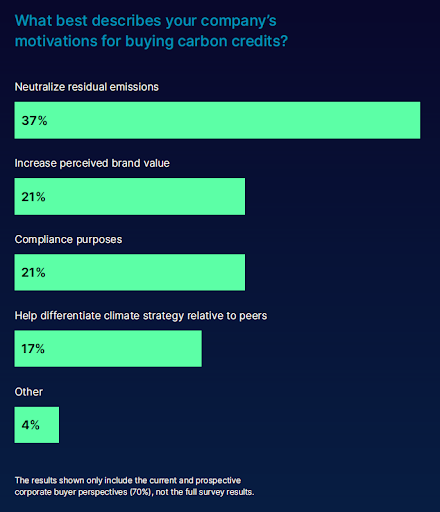
Evidence: These self-reported motivational customer segments are evident in the NASDAQ Global Net Zero Pulse report chart below (Sept 2024):

Granted these are for carbon credit markets writ large – i.e. traditional offsets and less durable nature-based solutions, not only for durable carbon removal – but I would offer that the structure stands, regardless of the type of carbon credit, be it avoidance, less durable CDR (<100 years), or higher durability CDR (>100 years). There is no monolithic rationale for buying durable carbon removal today. When a potential buyer reports that “prices of credits are too high”, the lesson is not that buyers think “you should find a way to lower your costs”, rather “prices are too high for what you are offering to meet what the customer views as valuable now”. The options for a startup to take, therefore, are either:

A) figure out a way to improve the value of the durable CDR credit delivered to the type of customer you are trying to address or 

B) Find a different customer who will find what you are delivering to be valuable.

Which leaves carbon removal suppliers at a standstill: if all prices are valid, then what should I charge?

One answer lies in a powerful survey tool that may be helpful: a Van Westendorp model. This technique can yield an acceptable price range for a given set of potential customers.

The four very specific questions asked in Van Westendorp analysis are:

      • At what price would you consider the product to be so inexpensive that you would feel the quality couldn’t be very good?
      • At what price would you consider the product to be priced so low that you would feel it’s a bargain?
      • At what price would you say the product is starting to get expensive, but you still might consider it?
      • At what price would you consider the product to be so expensive that you would not consider buying it?

The result, a chart that looks something like this example, with one line tracking each of the four questions, price points on the X-axis, and % of respondents who accept the price for that line description on the Y-axis (e.g. 80% of respondents consider $20 ‘Acceptably cheap’):

Source: sawtoothsoftware.com

And there are several ways of segmenting the data, assuming a large enough set of respondents. For instance, a survey team could segment by industry and see the different ranges represented there. Or ask intake questions (like in the NASDAQ survey example above) to divide up the respondent pool by motivations. Or conduct two sets of questions and change the delivery to be in 2025 vs 2030.

Additionally, you can ask these sets of questions twice, once for lower durability carbon removal, and another time for high durability carbon removal. Charts like the one above would have different price ranges for different purchase types. 

This would yield price ranges that offer a quantitative look at how much the value that a customer feels derives into a specific price that a supplier would charge. Then, suppliers would be able to focus on cost targets to become profitable and support their growth – and ability to satisfy the wants of new customers for their products.

The move from cost-based pricing to value-based pricing for CDR credits is just in its infancy, as many early stage technologies are just now starting to move down the internal cost curve. As internal costs decline in future years, startups can drive value by discovering a price point in line with what the customer’s willingness to pay will be, rather than purely to break even on operational costs. Even in the current market, CDR credit supply companies can learn a wealth of knowledge about building a value proposition story that unlocks a customer through offering additional benefits or driving home the message about the quality of carbon removal credits. And in doing so build sustainable businesses that use voluntary carbon markets to drive impact for the customers they serve as well as for the climate.

What do you think? Let me know here

Jason Grillo is a Co-Founder of AirMiners. The opinions expressed in this writing are the author’s own and do not reflect the position of any employer.

Free CDR Career Advice! – Climagination with Jason Grillo

TL;DR working to find a job in carbon removal can be hard work itself – some advice below on how to find the right team fit.

Photo by fauxels: https://www.pexels.com/photo/photo-of-people-holding-each-other-s-hands-3184433/

“Knowing yourself is the beginning of all wisdom” – Aristotle

Part of my dream for the carbon removal industry is a future where many thousands of people find gainful, meaningful employment for work to remove the legacy of excess greenhouse gas. For that vision to become reality – removing the first one billion tons before we believe it is possible today – requires a workforce that is educated, trained, and well-matched for the CDR jobs of the future.

To that end, through the people I’ve been lucky to meet in the carbon removal industry, I’ve been asked quite a bit about how to find a job in CDR. When welcoming new folks into AirMiners, the question of how to find a job is probably the topic most on the minds of those who are new to our community. That’s why in AirMiners we’ve done  two  events ( about this topic – Heidi Lim in particular has some excellent (and oft-cited advice) here.

One pillar of this is: how much can I expect to earn in carbon removal? And that data has been difficult to find. That is, until today with the release of an excellent global salary report created by the CDRJobs.earth team led by Sebastian Manhart.

Building on that hope for finding a job that inspires the best of you is why I’m writing this for you as a CDR job-seeking reader: to help you save time by asking three questions of yourself, about what makes you most effective to direct your efforts to fruitful career goals. 

Please note that these self-revealing questions constitute my own personal advice, and your own results may vary.

First, what is your one functional superpower that you bring to the table when approaching a carbon removal company? To be blunt: what is the one thing that you could do immediately in a new role without any on-the-job training? 

‘Functional expertise’ could be marketing campaign creation, operations or program management, corporate financial expertise, or any one of a wide variety of technical skills. And what concrete results have you driven in executing on this skill? In business school my classmates and I practiced the STAR framework to handle interviews: Situations,Tasks, Actions, and Results. What was the Situation you found yourself in, what Tasks were before you to achieve, what were your Actions to attain that goal, and what were the Results you ultimately arrived at. Quantifying those results is especially important: “I developed R or Python to research and analyze X number of deep datasets” “Our marketing campaigns achieved a 200% ROI!” / “We delivered this $5M project ahead of schedule and below budget” marks the success that attracts interest.

Not to discount passion – which is important – but a Grade ‘A’ record of performance plus passion is a compelling story. At the time of this writing, our industry is still in an early enough stage that top functional expertise from different industries will find a ready-made home. Not many have been in CDR for more than five years (myself included!), so bringing a strong transferable set of skills is by far the best way to build a compelling narrative to land a new role.

Second, what type of carbon removal do you like best? 

There are a wide – and I mean wide – variety of CDR methods on offer in these early years of the carbon removal industry. The trick is to figure  out which type of CDR suits your skills and interests – as soon as you can – which makes career searching in CDR  much easier. That way as a job seeker you can home in on how the superpower identified above can be useful in, say, marine CDR, Direct Air Capture, biochar, enhanced rock weathering, Measurement/Reporting/Verification, or any other type of carbon removal technology that provides meaning to you.¹

Carbon removal is a new enough industry that you as a job seeker can ask yourself what sparks your interest in a particular method of carbon removal. What is it about that method that makes you like it more than others, at a high level? If you don’t have that perspective, fortunately AirMiners own BootUp program² provides such an entry point, offering a broad overview of state-of-the-art CDR methods over the course of several weeks.

Most importantly get out and talk to people who are starting up these organizations! Find them on LinkedIn, at networking events, even (gasp) in our main AirMiners community or elsewhere. Ask yourself whether you can envision you working at the type of jobs for people in that method of CDR is a good fit.

Third question: what size organization would you like to work at? The landscape of carbon removal is very much the landscape of startups, though the term ‘startup’ covers a lot of ground in terms of risk and reward. Maybe you are a founder of a company. Maybe you are Employee Number 5, or Number 25, or Number 125 – all of those are new, small STARTUP businesses, with a high degree of risk around technological approach or business model. 

The real introspection to work on is: “in what environment am I most effective at driving results?” Will your 1 or 2 skills from Question 1 above be best unleashed with structure and resources? Or with freedom and latitude without as much to fall back on? Every person has different preferences – and prefers things at different points of their career, especially when factoring for personal and family needs.

The larger a company, even along the more differentiated a role tends to be, and possibly the more hierarchical. Smaller organizations tend to be flatter, favoring those who consider themselves generalists. Plus, compensation – especially for pre-revenue companies – would be more for equity rather than cash. 

Different people in a similar situation could pursue widely varied pathways. For example a recent graduate might want to develop the one functional skill that they know they want to fulfill throughout the next several years of their career, then climb a career ladder or switch companies. Or another recent graduate would say ‘nah, I need my space’ and found a startup or two (or three) in their first years in industry. Knowing yourself and where your talents may best take root – that’s the essence of how to start a job search.

And an added bonus question: How effective might you be in a remote vs. hybrid vs. in-office work environment? The COVID pandemic led to the rise of remote work, with some reversal of that trend in recent years. Fortunately many CDR companies – including small startups – are willing to take a risk and seek talent from a truly global pool rather than limit themselves to a particular geography. 

This post started off with the goal of developing a professional workforce in carbon removal; my hope is that you as a job seeking reader find the career journey a bit easier by asking questions of yourself to guide your job search in a new and growing field. 

Thanks for reading, and wishing you good job hunting!


Jason Grillo is a Co-Founder of AirMiners. The opinions expressed in this writing are the author’s own and do not reflect the position of any employer.
Mind the CDR Gap – Climagination with Jason Grillo


TL;DR: A gap exists between where we are and where we need to be in carbon removal by 2030, but with the right factors in play we can overcome it sooner than anyone thinks is possible today.

Hi there! 

Summertime travels are wonderful – the result of oftentimes weeks of planning for where you’re going and how to get there. In the carbon removal industry, we’re moving forward to a destination where gigatons of excess greenhouse gases are removed from the atmosphere.  “NetZero by 2050” is certainly an admirable target – we need to understand where the industry needs to get to by midcentury.

As much as future projections focus on 2050 goals, they can seem, well, a bit distant: nowhere near as much emphasis has been placed on what an interim 2030 goal might look like. And that’s an important goal because we can know now whether or not we are on track, and take actions if needed to meet an end-of-2030 target. A specific, measurable, achievable, relevant, and time-bound goal – 6 years away at the time of this writing – can inspire action today which can make that midcentury vision a reality.

That’s why I’m writing today about what might be 2030 interim CDR milestones for climate goals, a gap in where we might be, and a path forward to tackle that. 

To do this I’m going to outline a target, then use publicly available data sources of leading novel CDR methods to extrapolate a portfolio of projections to 2030. As defined in the State of CDR 2nd Edition report, “Novel” CDR includes DAC, BECCS, Biochar, Enhanced Rock Weathering, and marine CDR methods. 

Fair warning: this analysis includes many assumptions about future growth of various CDR sectors – and I very much welcome your scrutiny and constructive critical eyes. So please, comment away using the link at the end of this post!


What does a 2030 target look like?

To start off, let’s characterize the 2030 destination.

Fortunately, the aforementioned State of CDR report, 2nd Edition offers an excellent starting point. I’m presenting two scenarios outlined in Chapter 3 of that report: one where our climate settles on 1.5 degrees C without overshoot, and one with overshoot. The data for this comes from the data resources accompanying the report – again, publicly available, and free of charge!

The State of CDR team made multiple estimates, with a median of 260 Megatons of atmospheric CO2 to be removed in the year 2030 for the climate to be on track with the scenario of 1.5 degrees of warming without overshoot, and 70 Megatons with overshoot. 

Data sourced from State of CDR report, 2nd Ed, June 2024

Others have speculated that the 1.5C number requires as low as 190 Megatons; additionally or as high as 285 megatons. For the purposes of our gap conversation, I’m comfortable to stay with 260 megatons for a 1.5 degrees Celsius result without overshoot.


Where will the 2030 Megatons come from?

The short answer: everywhere! All solutions are on the table; a portfolio of approaches – some of which are not delivering tonnage yet – are going to contribute to getting to the result. To forecast what a 2030 scenario might look like I’m going to use some existing estimates here from citable sources, and also create some projections of my own based on growth assumptions.


Contributions by DAC and BECCS in 2030 

know that Microsoft and Frontier in particular have gone quite deep in funding new BECCS projects, particularly in Scandinavia. The State of CDR Report Chapter 3 has an excellent chart (below) based on companies’ announced plans to build and deploy BECCS and DAC capacity through 2030. BECCS in particular is indicated to have a capacity of ~20 MT in 2025, rising to ~60 MT by 2030; DAC in 2030 is also projected to be 60 MT, for a 120 MT total between these two methods.


Some caveats: this likely reflects the facilities’ nameplate capacity, so actual tonnage removed – might not perform as well. 

Second, as with all company estimates, delayed and canceled project deployments may diminish future results. 

Contributions by Biochar in 2030  

Per CDR.FYI we know that Biochar is delivering the vast majority of CDR tonnage today and is selling well now, and is poised to grow in future years. By how much is an open question. For the 2030 estimate, I am going to assume linear growth of tons of biochar produced based on the 2023 Market estimates from the International Biochar Initiative/US Biochar Initiative 2023 Global Market report

Growing from ~96,000 tons to ~352,000 tons represents a 3.6x increase in physical char produced over two years from 2021 to 2023. Assuming this trend of linear growth continues, then in the year 2030, 31 million tons of biochar worldwide would be produced. And since one ton of biochar contains ~2.8 tons of CO2 (source: 2023/24 European Biochar Market report), that figure represents approximately 87 million tons of CO2 stored in the year 2030.

Note that this figure is the tons of physical biochar produced rather than the quantity of registered carbon credits from them – regardless of whether a biochar producer is selling credits, the physical char stores embodied carbon and represents carbon removed from the atmosphere. Adapting a phrase, if a tree gets pyrolyzed in a forest, and nobody registers the credit, it still does reflect removed carbon (and yes will probably make a sound 😉).

Contributions by Enhanced Rock Weathering in 2030

For ERW, the data are a bit more scant, though the Boston Consulting Group offers insights from their 2023 report on carbon removal. With a forecast that 33 megatons will be removed by the entire CDR industry in 2030, 9% of which is ERW, BCG’s result is that ~3 Megatons of CDR will be achieved by enhanced weathering in that year.

That said, I offer that there could be some upside to this – weathering rates and CO2 uptake rates are still under research. And it is possible that deployments may outpace estimates as of now.

The estimated gap

The sum total of those four methods that we have credible 2030 estimates for is 204 megatons to be removed in that year, leaving a gap of 56 megatons to be fulfilled by other methods or by outpacing the projected trajectories of the methods mentioned above.

How to make up a gap? 

  1. Bring additional methods to scale.

Marine CDR in 2030 could contribute to reducing the gap mentioned above, however it is challenging to estimate since most startups are not (yet!) reaching volume at the time of this writing. However, I agree that a suite of marine solutions could be enough to fill the gap (and more on that below) however, projecting into the future is a challenge.

Fundamental research now in mCDR would set the stage for significant deliveries to take place in the year 2030 – particularly for Ocean Alkalinity Enhancement, or macroalgae sinking. BCG suggests a 100Mt in 2050 figure across all ocean methods, rather than offer a 2030 estimate.

Biomass burial and storage is also just now starting to gain a foothold, with over 180,000 tons sold and over 3,000 tons delivered at the time of this writing per CDR.FYI. This solution is scaling rapidly. Assuming that 75% of the 180k tons sold to date are delivered in 2024, and this grows at the same rate as biochar 3.6x every two years (yes, a big IF), then burial solutions would contribute 3M in 2030. 


2. Keep pushing to outpace the estimate of the four methods that I included above (BECCS, DAC, Biochar, and ERW). Growing any field of carbon removal is not inevitable, but rather the result of people researching, deploying, and learning how to efficiently advance the practice of removing excess atmospheric greenhouse gas. The ability to advance faster than forecasts is not fanciful – but happening for key climate technologies already. 

It is my belief that carbon removal can model the systemic adaptations present in these industries – innovations in financing, policy advancements, improved social license to operate through awareness and endorsement – leading to deployment and expansion beyond linear estimates. 

In other words, we can close the carbon removal gap – and despite the many challenges that carbon removal faces, that can happen sooner than anyone thinks today.


-Jason Grillo is a Co-Founder of AirMiners. Opinions expressed here are the author’s own and do not represent the position of any employer.