ICR Fact Sheets Provide a Comprehensive Overview of All Things Carbon Removal

Although the emerging field of carbon removal has great potential to help curb climate change when coupled with more traditional methods of mitigation, it is riddled with uncertainty. There are many risk factors and many components within each individual method that are still poorly misunderstood. The Institute for Carbon Removal Law and Policy is dedicated to creating a set of comprehensive tools that can aid in providing clarity on carbon removal practices and technologies on many different levels.

Among these valuable resources are a comprehensive set of Fact Sheets that provide overviews on each of the individual topics regarding carbon removal, the production of which was provided for by a grant from The New York Community Trust. These fact sheets are broken down into two categories, topics in carbon removal and approaches to carbon removal. 

The topics in carbon removal fact sheets provide an overview and background on:

What is carbon removal?

Nature-based solutions to climate change and 

Carbon capture & use and carbon removal

The approaches to carbon removal fact sheets break down the ten different topics, providing a deeper context to the potential methods behind carbon removal. Each of these provides not only an overview but weigh in on the co-benefits & concerns, potential scales and costs, technological readiness, governance consideration, and provide sources for further readings. These methods include:

Agroforestry: Incorporates trees with other agricultural land use which not only removes carbon dioxide but also provides benefits to farmers and their communities.

Bioenergy with carbon capture and storage: A technique dependent on two technologies. Biomass that is converted into heat, electricity, liquid gas, or fuels make up the bioenergy component. The carbon emissions generated from this bioenergy conversion are then captured and stored in geological formations or long-lasting products, this being the second component of this method.

Biochar: A type of charcoal that is produced by burning organic material in a low oxygen environment, converting the carbon within to a form that resists decay. It is then buried or added to soils where that carbon can remain harbored for decades to centuries.

Blue Carbon: Refers to the carbon that is sequestered in peatlands and coastal wetlands such as mangroves, tidal marshes and seagrass among others, many of which have been destroyed in recent decades. 

Direct Air Capture: An approach that employs mechanical systems that capture carbon directly and compress it to be injected into geological storage, or used to make long-lasting products.

Enhanced Mineralization: Also known as enhanced or accelerated weathering. Accelerates the natural processes in which various minerals absorb carbon dioxide from the atmosphere. One implementation involves grinding basalt into powder and spreading it over soils, causing a reaction with CO2 in the air, forming stable carbonate materials.

Forestation: This includes forest restoration, reforestation and afforestation. Forests remove carbon dioxide and through the trees within, and have the potential to store that carbon for long periods of time.

Mass Timber: A method that involves utilizing specialized wood products to construct buildings, therefore replacing emission-intensive material such as concrete and steel. Further, this wood stores carbon that was captured from the atmosphere through photosynthesis. 

Ocean Alkalization: A process involving adding alkaline substances, such as olivine or lime, to the seawater to enhance the ocean’s natural carbon sink.

Soil Carbon Sequestration: Also referred to as “carbon farming” or “regenerative agriculture.” This process involves managing land in ways that promote carbon absorption and sequestration within soils, especially prominent among farmland.

By reviewing each of these succinctly written fact sheets, it is possible for one to gain a solid understanding of what is happening in the world of carbon removal; the good, the bad, and the misunderstood. 


NGO Engagement with Carbon Removal: Announcing a New Project for the Institute for Carbon Removal Law and Policy and the Union of Concerned Scientists

Authored by Allison Tennant, Project Assistant, Institute for Carbon Removal Law and Policy & Union of Concerned Scientists

Two years ago, The Institute for Carbon Removal Law and Policy (ICR) convened a group of representatives from over 20 national environmental groups at the Wingspread Center in Racine, WI. The goal was to spark and facilitate an ongoing sharing of perspectives and resources about carbon removal. Space was created for meeting attendees to probe various carbon removal approaches and issues, with the intent that information and findings from the meeting would inform exploration of carbon removal in their home institutions. 

Now, ICR has partnered with the Union of Concerned Scientists for a new and newly imagined round of work with the NGO community. In my new position, created with the kind support of the New York Community Trust, I will be reconvening the group that gathered at Wingspread and working with them to imagine and promote a more just, equitable, and inclusive understandings of carbon removal. We will be seeking to expand the carbon removal conversation to draw on the knowledge, interests, and perspectives of a wider array of voices, recognizing that different carbon removal approaches are poised to have implications across a diverse set of sectors and communities.

As the IPCC Special Report on Global Warming of 1.5°C makes clear, carbon removal will need to be a part of the approach to keeping warming under 1.5°C; emissions reductions alone will no longer be enough. Governments and companies must now make large investments in R,D&D of carbon removal approaches to get technologies up to scale. Just as importantly, we need robust forms of evaluation and assessment of carbon removal options to ensure that any developments in this fast-moving field are attending to social and environmental imperatives. Careful evaluation of what carbon removal can and can’t do won’t happen without increased attention by civil society actors. 

With an upcoming US presidential election, there is an opportunity for increased funding towards carbon removal, but there are also equity issues and guardrails to be considered. Over the next weeks and months, we’ll be working with the Wingspread group and an expanding set of civil society actors to find out what carbon removal questions still need to be addressed and work with them to try to figure out answers. They don’t all have to be on the same page, but the dialogue will help expose existing issues and workshop potential solutions. It’s going to be a big project, and I’m excited to see what will come out of it.

If you’re interested in finding out more about this new joint project between the Institute for Carbon Removal Law and Policy and the Union of Concerned Scientists, please contact me: ATennant@ucsusa.org. 

The Democratic Party’s Draft Policy Platform and the Potential Role of Carbon Dioxide Removal/Negative Emissions Technologies to Combat Climate Change

Authored by Wil Burns, Co-Director, Institute for Carbon Removal Law & Policy, American University

The Democratic party’s draft policy platform, drafted by the Democratic National Committees platform drafting committee, was released this week. The platform will be considered by the delegates to the upcoming Democratic National Convention in Milwaukee convention next month, where the delegates will make final decisions on the text of the non-binding policy document. 

The draft’s climate section contains a number of provisions pertinent to carbon dioxide/negative emissions approaches, including the following:

  • In seeking to develop a “thriving, equitable, and globally competitive clean energy economy,” the United States should seek to “develop and manufacture next-generation technologies to address the climate crisis …” [p.44]. These technologies include “direct air capture and net-negative emissions technologies,” as well as “carbon capture and sequestration that permanently stores greenhouse gases …” [p. 48).  The platform also calls for support for “the most historically far-reaching public investments and private sector incentives for research, development, demonstration, and employment of net-generation technologies …” [p. 48];
  • In pursuit of the objective of eliminating power plant carbon pollution by 2035 to “reach net-zero emissions as rapidly as possible [and no later than by 2050],” decarbonization strategies should include carbon capture and storage [p. 45];
  • In the context of the agricultural sector, the platform calls for a partnership to help farmers develop new sources of income including through, inter alia, lower-emission, and regenerative agricultural practices.” [p.47] While the contours of these practices are not outlined in the document, one would presume that it would include methods to rebuild soil organic matter, such as no-till agriculture and cover crops;
  • There are also several provisions related to public lands stewardship that, albeit vague, might help facilitate enhanced carbon sequestration. The platform calls for the development of a youth corps to conserve public lands. [p. 45] Moreover, it advocates full funding of the Land and Water Conservation Fund to ensure the conservation of public lands, as well as programs to incentivize conservation initiatives on private lands, “including through private sector ecosystems markets.” [pp.48-9];
  • There is only one reference to the potential role of afforestation/reforestation in climate policy, with a focus on temperature impacts, with the platform calling for the planting of “millions of trees” in urban areas to “help reduce heat stress.” [p. 47]

The drafters’ engagement in the potential role of CDR/NETs approaches in climate policymaking is laudable, and reflects a potentially expanded role for such options compared to that contemplated in the New Green Deal, which briefly discussed tree-planting as a carbon sequestration strategy. At the same time, the draft platform is also an extremely underdeveloped set of proposals in terms of fleshing out potentially requisite levels of funding, necessary regulatory frameworks to facilitate research, development, and potential deployment of many of these options, and the daunting issue of how to integrate such approaches into the current climate policymaking domain at the state, national and international level. It is also notable that one of the most widely discussed potential carbon dioxide removal approaches, afforestation/reforestation, is given extremely short shrift in the document, with the only reference to tree planting focused on albedo effects rather than carbon sequestration potential. While the delegates will have the opportunity to hone the document, it’s unclear if they will have the expertise to address some of these concerns. 

However, in the end, perhaps it’s helpful in itself to have a major party acknowledge the potentially important role of CDR/NETs options in pursuing the critical objective of net emissions neutrality in the next few decades. The platform establishes a foundation for the hard work that would inevitably need to follow to make this a reality. 

The technological and economic prospects for CO2 utilization and removal

Authors:

Cameron Hepburn, Ella Adlen, John Beddington, Emily A. Carter, Sabine Fuss, Niall Mac Dowell, Jan C. Minx, Pete Smith & Charlotte K. Williams

Abstract:

Carbon dioxide utilisation – making valuable products from CO2 – is a potential way to lower the net costs of reducing emissions or of removing carbon dioxide from the atmosphere.  We review the economic and technological prospects of ten such pathways to assess scale and cost prospects in 2050. Using CO2 in chemicals, fuels, and via microalgae to make products, comprise ‘cycling’ pathways: they might reduce carbon dioxide emissions by displacing fossil fuel derived CO2 but they have limited potential for carbon dioxide removal.  Some CO2 chemicals, such as CO2 based polymers, are profitable in the present day, but CO2 based fuels are high up on the cost curve. ‘Closed’ pathways such as those involving construction materials can both utilise and remove carbon dioxide for the long term. They might be low cost, and the end-markets are large, but they have high regulatory barriers to scale.  Land-based CO2 utilisation pathways such as soil carbon sequestration, afforestation/reforestation and biochar can increase agricultural output and remove carbon dioxide. They can be characterised as ‘open’ pathways wherein the CO2 can return to the atmosphere easily, and they are relatively low cost. Using a process of structured estimation and an expert opinion survey, our assessment suggests that each of the ten pathways could scale to over 0.5 Gt carbon dioxide utilisation annually, although barriers remain substantial and resource constraints prevent the simultaneous deployment of all pathways.  Uncertainty over scaling means that there is a wide range of potential outcomes for 2050. Notwithstanding the many caveats, the potential scale of utilisation could be considerable. Much of this potential CO2 utilisation – notably in ‘closed’ and ‘open’ pathways – may be economically viable without dramatic shifts in prices. The specific assumptions of the low scenario imply an upper bound of over 1.5 Gt CO2 yr-1 at well under $100/t CO2u. For policymakers interested in climate change, these figures demonstrate the theoretical potential for correctly designed policies to incentivise the displacement of fossil fuels or the removal of CO2 from the atmosphere.  


Fixing the Climate? How Geoengineering Threatens to Undermine the SDGs and Climate Justice

Author: Linda Schneider

Summary:

Over the past two decades, policy-makers and economists have often talked about climate policy in terms of the social cost of carbon. The social cost of carbon is the monetary cost that future generations incur due to decreased economic growth caused by the emission of one tonne of CO2 today. Many economists and policy-makers have suggested using the social cost of carbon as a just means of setting a carbon tax. After all, if my emission of 1 tonne of CO2 incurs a cost of $50 to future generations, it seems fair that I should be taxed at $50 per tonne.

Estimates of the social cost of carbon vary widely, and it has a number of practical and philosophical problems. Practically, estimates of the social cost of carbon range over about 7 orders of magnitude, which makes using it in policy challenging. Philosophically, imagine that climate change leads to a famine that kills a few million people. The famine would be a profound social cost of climate change, but might have little impact on the global economy, and thus would not be counted in estimates of the social cost of carbon. Thus, another metric is needed.

Here, we suggest that the costs of atmospheric removal of CO2 could be a better metric for climate change policy. There are a number of technologies that remove CO2 from the atmosphere (called carbon dioxide removal or negative emissions technologies) but, like most other pollution control systems, they require financial inputs. We propose that the per tonne subsidy needed to capture and store CO2 from the atmosphere would be a more appropriate metric than the social cost of carbon because it would allow for a climate policy that is based on an observable cost and could be directly linked to the physical removal of CO2 from the atmosphere. In the proposed policy, emitters would pay a tax, based on the marginal cost of CO2 removal and the proceeds from that tax would be used to remove an equivalent amount of CO2 from the atmosphere.

While more research on the costs of negative emissions technologies is needed, early estimates suggest that a negative emissions-based system would be higher than the social costs of carbon preferred by policy-makers but roughly similar to the average social cost of carbon derived from academic estimates. 

Abstract:

In the early 21st century, the world faces multiple existential challenges and global crises – among them is the climate crisis, but equally dramatic – and intimately related – are the escalating loss of biodiversity and natural ecosystems, growing social inequality, human rights violations, poverty and hunger, concentration of wealth, power and control, and authoritarian state tendencies. 

The international community adopted the Sustainable Development Goals (SDGs) in 2015, which aim to, among other goals, end poverty, hunger, reduce inequality, protect life on land and achieve gender equality, peace and justice. The framework of climate justice, promoted by grassroots social movements around the world, highlights the crucial role of global environmental and social justice in addressing the climate crisis – rather than treating it as a purely technical problem.

Both the SDGs at the international-institutional level, and the call for climate justice from the grassroots and social movement level, serve as a framework for addressing the interrelated crises of the 21st century in an integrated fashion. 

In the wake of the Paris Agreement, however, and with global emissions still on the rise, one set of alleged responses to the climate crisis is pushing to the front in international climate policy discussions. 

Geoengineering—large-scale technological interventions in the Earth’s natural processes and ecosystems are being promoted to counteract or delay some of the symptoms of climate change.

In the present paper I argue that geoengineering – both large-scale Carbon Dioxide Removal and Solar Radiation Management, the two main categories of climate geoengineering – are fundamentally at odds with the SDGs and with the strive for climate justice. In fact, they threaten to undermine the achievement of SDGs and climate justice for three broad reasons that I develop in the present article.

First, geoengineering is bound to exacerbate many of the other socio-ecological and socio-economic global crises we are facing. I show this for several of the proposed geoengineering technologies on land, in the oceans and in the atmosphere and how they would detrimentally affect the SDGs and the strive for climate justice. 

Furthermore, I elaborate on how geoengineering would deepen societal dependence on large-scale technological systems and on technocratic elites controlling them. One of the effects of such technological dominance in trying to solve global problems is that alternative and more holistic forms of knowledge, expertise, and practices that allow for complexity, diversity and resilience are excluded. By the same token, concerns over ecological and social risks and rights violations are pushed aside. Such one-dimensional large-scale technological fixes for the climate crisis run counter the aim of achieving global ecological and social justice and redressing past unjustness.

Finally, rather than overcoming the economic and political power structures that have caused the climate crisis in the first place, they create new spaces for profit and power for new and old economic elites and thereby serve to uphold the current status quo. As such, it is fundamentally incompatible with the notion of climate justice and will make it impossible to achieve the SDGs.

Southern Ocean Iron Fertilization: An Argument Against Commercialization but for Continued Research Amidst Lingering Uncertainty

Author: Tyler Rohr

Affiliations:

Current:

United States Department of Energy, Water Power Technologies Office, Washington D.C., USA

Past (but at time of original writing):

Massachusetts Institute of Technology, Department of Earth and Planetary Sciences, Cambridge, Massachusetts, USA 

Woods Hole Oceanographic Institution, Department of Marine Chemistry and Geochemistry, Woods Hole, Massachusetts, USA 

Abstract:

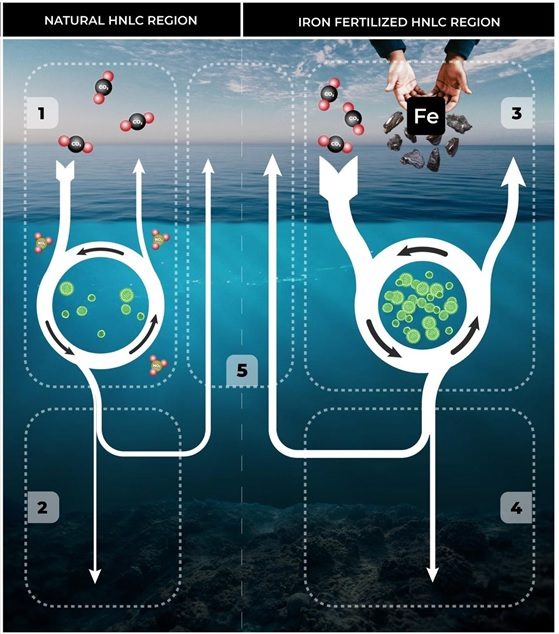
With substantive global action on climate change mitigation sputtering, some have begun to look at geoengineering as a possible alternative. Geoengineering is any deliberate, large-scale, manipulation of natural processes to affect the climate system, ostensibly to curb the effects of global warming. One such strategy is Southern Ocean Iron Fertilization, which seeks to remove carbon dioxide from the atmosphere by fertilizing the growth of marine phytoplankton in the ocean. Phytoplankton are microscopic plants that, like land-based plants, convert carbon dioxide into oxygen through photosynthesis. Together, marine phytoplankton produce half the oxygen we breathe. Further, when they die, they can sink out of the surface ocean and trap carbon in the deep ocean for hundreds of years. The goal of Southern Ocean Iron Fertilization is to increase this oceanic drawdown of carbon dioxide by stimulating marine phytoplankton growth by adding iron, an important nutrient, to large parts of the ocean where there is currently not enough iron to support growth. The notion of simply dumping dissolved iron into the ocean is seductively cheap compared to other forms of climate action, but it is not yet clear that fertilizing the Southern Ocean could actually create a sustainable carbon sink. A comprehensive review of the literature reveals that iron fertilization will almost certainly increase phytoplankton growth in the surface ocean, but it is much less clear how much of that carbon will sink out of the surface ocean and stay there versus how much will quickly end up back in the atmosphere. Given the lingering scientific uncertainty, it would be ill-advised to commercialize iron fertilization under emerging carbon offset markets. Offset markets allow companies or individuals to buy and sell activity that offsets their own emissions, either by sequestering carbon or reducing emissions elsewhere. Compliance offset markets, such as many proposed cap-and-trade frameworks, are carefully regulated to ensure activity is legitimate and appropriately compensated; however, voluntary offset markets, powered predominately by a sense of social responsibility, are not necessarily well regulated. Commercializing Southern Ocean Iron Fertilization on compliance offset markets is unlikely, and unadvisable, due to concerns over the strategy’s fundamental feasibility, the potential for unpredictable side-effects, and the inability to establish reliable baselines or accurately measure the full effects of fertilization, making it impossible to provide fair and consistent compensation. Never-the-less, recent history shows that fertilization activity on unregulated voluntary offset markets motivated by a the promise of an easy fix can, and will continue to, emerge. Continued research is needed to constrain the public perception and clarify the reality of an iron bullet.


Figure Caption: Idealized schematic of carbon cycling and the biological  in a natural High Nutrient Low Chlorophyll Region (HNLC) and an iron fertilized HLNC. White arrows represent carbon transport. The addition of iron may dramatically increase surface biomass but only a small fraction of that is additional sequestered in the deep ocean or the sea floor.

Link: http://www.sciencepolicyjournal.org/uploads/5/4/3/4/5434385/rohr_jspg_v15.pdf

Carbon Removal Corporate Action Tracker

The terms carbon neutral, carbon negative, and net-zero, long familiar to scientists and environmentalists, are beginning to pop up in corporate press releases. Recently, corporations from sectors ranging from aviation to finance to retail have made commitments to an emerging form of climate action called carbon removal. Carbon removal, also known as carbon dioxide removal or negative emissions technologies, has been receiving increased attention from corporations since the landmark IPCC Special Report on Global Warming of 1.5°C identified it as crucial to limiting global warming below 1.5°C and warned that the world can no longer hit this target without it. 

As a response to the growing number of corporate climate pledges, the Institute for Carbon Removal Law and Policy at American University has created an Action Tracker outlining some interesting moves regarding climate action in aviation, energy, heavy industry, and other harder-to-abate sector, as well as large financial actors and retail companies. The Action Tracker includes companies that have made climate pledges that entail some use of large scale carbon removal. Some of these  companies have pledged to become carbon neutral or reach net-zero emissions, while others have plans to become carbon-negative, meaning that they will be removing more carbon dioxide from the atmosphere than they emit. Companies with carbon negative pledges include Ikea, Microsoft, Starbucks, AstraZeneca, and Horizon Organics. 

Also included in the Action Tracker are companies in harder-to-abate sectors such as aviation, steel, and cement that are making carbon neutral commitments without any apparent commitment to carbon removal. Given how challenging it is to decarbonize these sectors, any pledge to carbon neutrality in those sectors invites questions about how a particular company aims to become carbon neutral and what role, if any, carbon removal plays in each company’s plan. 

A few companies in the retail sector, such as Horizon Organics and Starbucks, have independently pledged to be carbon-negative (confusingly called “carbon positive” in a few cases) using carbon removal. Many more retail companies have committed to becoming net-zero as part of the Certified B Corporations Net-Zero by 2030 pledge but lack specific plans for fulfilling their commitment.

Finally, the Action Tracker includes actors in the financial sector, such as Barclays and Harvard’s endowment, that have pledged to make their investments carbon neutral, meaning that the net carbon footprint of the activities they finance will be zero. These plans are likely to take different forms. Harvard, for instance, has indicated that its endowment managers will finance carbon removal to balance investments in greenhouse gas-emitting activities, whereas Barclays has aligned itself with the International Energy Agency’s Sustainable Development Scenario, which explicitly excludes carbon removal. Given the importance of finance to reaching net-zero or net-negative emissions globally, the Institute finds these sorts of pledges worth tracking.

The Action Tracker is an ever-evolving resource and will be updated as new commitments are released, current pledges become more detailed, and mechanisms to achieve outlined commitments are specified.

Please email icrlp@american.edu if you have other interesting examples of carbon negative or carbon-neutral-with-carbon-removal pledges.

Decision making in contexts of deep uncertainty – an alternative approach for long-term climate policy.

Authors: Mark Workmana,b, Kate Dooleyc,Guy Lomaxd, James Maltbye, Geoff Darchf,

  1. Visiting Researcher, Energy Futures Lab, Imperial College London, South Kensington, London SW7 2AZ, UK
  2. Corresponding Author available on mark.workman07@imperial.ac.uk 
  3. University of Melbourne, School of Geography, Parkville, Melbourne 3010, Australia
  4. The Nature Conservancy, 26-28 Ely Place, London, EC1N 6TD
  5. Defence Scientific Technology Laboratory (DSTL), Portsdown West Fareham PO17 6AD
  6. Anglian Water, Block C – Western House, Peterborough Business Park, Lynch Wood, Peterborough PE2 6FZ

Key Words: 

International Climate Policy | Carbon Dioxide Removal Technologies | Integrated Assessment Modelling | Predict then Act | Robust Decision Making | Pluralistic Approaches | Diversity in value-sets

Highlights: 

  • Integrated Assessment Models (IAMs) have been used to inform international climate policy development.
  • There is a strong tendency to view IAMs as providing objective analysis, however, they are developed within a very small, narrow community and can heavily distort decision making processes.
  • The largescale (Billions of tonnes pa) reliance of IAM scenarios on Carbon Dioxide Removal (CDR) is one such distortion; this is problematic for a number of reasons.
  • Most worrying, dependence on CDR is being baked into international emissions targets without a public debate.
  • This is likely to lead to polarisation as a function of the trade-offs and side-effects of large-scale CDR deployment; this is likely to hinder progress on CDR and alternative mitigation strategies.
  • Approaches to allow diversity in value-sets in climate policy making is essential – Robust Decision Making Approaches is provided as an exemplar to accommodate this.

Abstract

Scientists have produced a significant body of analysis detailing how we might mitigate so as to avoid dangerous levels of global warming. The dominant analytical tools are integrated assessment models (IAMs), which represent the world’s energy, agricultural and land systems over a time period spanning from the present to (most commonly) the end of the 21st century. As noted in recent high-profile commentaries, these models do not consider – or at least have not been used to explore – how unexpected disruptions could impact either positively or negatively on carbon policy efforts.  Most importantly they are constructed by a narrow elite with limited engagement with the publics and heavily distort decision making in climate policy development.  As the world struggles with increased complexity and uncertainty, there is the need to introduce the process of systematically imagining alternative, sustainable futures that should be conducted in a more democratic and inclusive manner. As distrust in institutions grows and societies become more polarised, there is the need to explore alternative and emerging methods that are being used to bring communities together to debate and create collective visions for the futures they desire. 

One of the most high profile distortions in climate policy development has been that the majority of global emissions scenarios compatible with holding global warming to less than 2°C depend on the large-scale use of bioenergy with carbon capture and storage (BECCS) of up to 15 billion tons pa – to compensate for an overshoot of atmospheric CO2 concentrations. Recent critiques have highlighted the ethical and environmental risks of this strategy – The scale of carbon removal deployment would rival the worlds’ largest industries and sectors such as Oil and Gas and Agriculture.  At present less than a few thousand tonnes of carbon dioxide are removed annually.

In this paper, we critically examine both the use of BECCS in mitigation scenarios and the decision-making philosophy underlying the use of integrated assessment modelling to inform climate policy. We identify a number of features of integrated assessment models that favour selection of BECCS over alternative strategies. However, we argue that the deeper issue lies in the tendency to view model outputs as objective science, capable of defining “optimal” goals and strategies for which climate policy should strive, rather than as exploratory tools within a broader policy development process. Effectively, a model-centric decision-making philosophy is highly sensitive to uncertainties in model assumptions and future trends, and tends to favour solutions that perform well within a narrow modelled framework at the expense of exploring a wide and diverse mix of strategies and values.

Drawing on the principles of Robust Decision Making, we articulate the need for an alternative approach that explicitly embraces uncertainty, multiple values and diversity among stakeholders and viewpoints, and in which modelling exists in an iterative exchange with policy development rather than separate from it. Such an approach would provide more relevant and robust information to near-term policy-making, and enable appropriate goals for climate policy in a given context being agreed and defined by dialogue between multiple stakeholders rather than ex ante by a single community.


Estimating economic and environmental benefits of urban trees in desert regions

Authors: Rima J. Isaifan1, Richard W. Baldauf2

1Division of Sustainable Development (DSD), Hamad Bin Khalifa University (HBKU) / Qatar Foundation (QF), Education City, P.O. Box 5825, Doha, Qatar.

2Office of Research and Development, United States Environmental Protection Agency, The United States

Full Citation: Rima J. Isaifan, Richard W. Baldauf, Estimating economic and environmental benefits of urban trees in desert regions, Frontiers in Ecology and Evolution, in press, doi: 10.3389/fevo.2020.00016

Abstract: 

Air pollution in urban areas has drawn significant attention from researchers, urban planners and policy makers due to the rapid increase in industrial, transportation and construction activities and its link with adverse human health effects. Several mitigation measures have been proposed recently including planting trees for abatement of air pollution. Vegetation can remove particulate matter (PM) and gaseous pollutants by deposition and absorption through leaves and branches.  Trees also convert carbon dioxide into oxygen through the process of photosynthesis. In urban areas, vegetation has also been reported to have significant positive impacts on raising property values, intercepting storm water runoff and improving air quality. Moreover, trees provide various ecosystem services in urban contexts such as the regulation of temperature by providing shading and thermal comfort. 

Despite these economic and environmental benefits, few studies have considered the efficiency of different urban tree species to reduce air pollution in desert cities experiencing high PM concentrations due to anthropogenic and natural sources along with providing other positive ecosystem services. In general, the ability of trees to improve air quality varies because of different plant characteristics. The effect of leaf surface structure, for instance, has been shown to have a major influence on PM capture and removal.

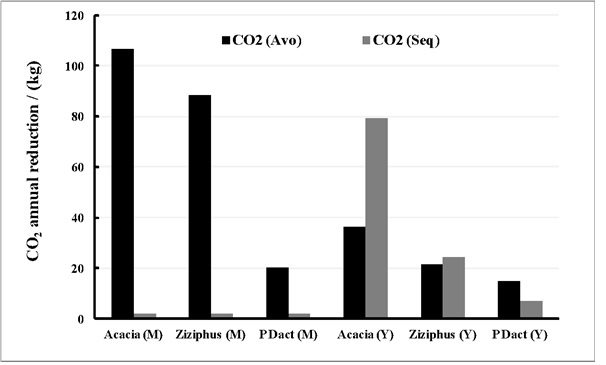
In this article, we estimated the economic and environmental benefits of three tree species typical for desert regions: Acacia tortilis, Ziziphus spina-christi and Phoenix dactylifera. The benefits varied by species with Acacia tortilis having the highest overall benefits, mostly because of its large leaf surface area and canopy shape. Mature trees tended to be more beneficial than smaller, young trees for improving environmental conditions. The location of trees had minimal impact on the overall economic value when considering regional benefits, although locations close to air pollution sources may provide additional air quality benefits. This assessment provides urban planners, foresters, and developers in desert regions with information needed to make informed decisions on the economic and environmental benefits of urban tree planting.

Annual CO2 reduction by trees in urban desert areas. Note: “M” indicates mature trees with trunk diameter of 45 in. or greater, “Y” indicates young tress with trunk size of less than 10 in, “P Dact” indicates Phoenix Dactylifera [the article].


From Zero to Hero?: Why Integrated Assessment Modeling of Negative Emissions Technologies Is Hard and How We Can Do Better

Authors: Jay Fuhrman1, Haewon McJeon2, Scott C. Doney3, William Shobe4 and Andres F. Clarens1*

1Department of Engineering Systems and Environment, University of Virginia, Charlottesville, VA, United States

2Joint Global Change Research Institute, University of Maryland and Pacific Northwest National Laboratory, College Park, MD, United States

3Department of Environmental Sciences, University of Virginia, Charlottesville, VA, United States

4Batten School of Leadership and Public Policy, University of Virginia, Charlottesville, VA, United States

Full citation: Fuhrman, Jay, Haewon McJeon, Scott C. Doney, William Shobe, and Andres F. Clarens. “From Zero to Hero?: Why Integrated Assessment Modeling of Negative Emissions Technologies Is Hard and How We Can Do Better.” Frontiers in Climate 1 (2019): 11. https://doi.org/10.3389/fclim.2019.00011.

Abstract: Integrated Assessment Models (IAMs) of the Earth’s economic and climate system increasingly rely the presumed future ability to achieve negative emissions in order to limit global warming to “well below 2 C” by 2100.  The scales at which these models project so-called “negative emissions technologies” (NETs) to be deployed rivals that of our current (positive) emissions.  There are a number of ways in which we could in theory remove CO2 from the atmosphere, all of which have their own set of potential synergies and tradeoffs with other goals for sustainable development. Yet the vast majority of scenarios assume the availability of just two NETs: bioenergy with carbon capture and storage, and afforestation. Just as the impacts of climate change itself will fall disproportionately on the developing world, IAM results suggest that so too, would the impacts of removing already-emitted CO2 from the atmosphere using these methods. In all regions of the world but especially Asia, Latin America, and Africa, enormous amounts of land would need to be converted to bioenergy crop cultivation or managed forest, with profound implications for food security and biodiversity.  Only a few recent studies have incorporated direct air capture, a fully engineered process previously thought too expensive to be viable but now receiving increasing attention. Other NETs (e.g., coastal wetlands restoration, accelerated weathering) have largely been excluded from IAM scenarios because they lack obvious connections with existing economic sectors. Our analysis finds that more complete treatment of NETs by IAMs could highlight substantial opportunities for more limited, sustainable deployment now, provided the appropriate policy incentives. But modeling results suggesting large-scale future deployment of NETs should be communicated to and interpreted by policymakers and other stakeholders as warnings of the potential impacts of the NETs themselves, rather than prescriptive licenses to delay taking action and attempt to reverse the damage later.

Read the full article in Frontiers in Climate here.