
Empirical evidence based on the South Korean economy suggests that the current structure of the paid care sector, rigid work arrangements, and entrenched gender norms may have pushed the South Korean economy into a state in which there are tensions between promoting women’s labor force participation and gender equality on one hand and meeting the growing demand for caregiving on the other.
GEM-Care Korea: The First Care-Focused Computable General Equilibrium Model

In a joint endeavor between the Center for Transnational Migration and Social Inclusion (CTMS) of Seoul National University’s and the Care Work and the Economy Project, the first gender-aware Social Accounting Matrix (SAM) of South Korea was constructed for the estimation of a new macroeconomic model called GEM-Care (or General Equilibrium Model for Care Analysis). This macroeconomic model, built by Martin Cicowiez and Hans Lofgren, incorporates features that reflect the sources of gender bias in the Korean economy – a gender wage gap, lower labor force participation of women relative to men, and family caregiving that falls heavily on women (Cicowiez and Lofgren 2021).
The findings from the model warn that focusing on the growth of economic production, as measured by GDP, at the expense of the unpaid care work within the family (not included in GDP), can lead to a misleading assessment of the economy’s total productivity and social well-being.
In other words, the gain in GDP-related production that comes mainly from a reallocation of labor away from non-GDP production is ultimately costly for Korea. Simulations in Cicowiez and Lofgren (2021) reveal that policies that alleviate the care burden within families will improve the well-being in the population by freeing up women’s time for employment that matches their education, thus raising women’s wages relative to men’s, and by encouraging a more equitable division of care responsibilities within the family.
As with many other developed countries, Korea faces multiple challenges related to care and gender: meeting the care needs of its rapidly growing elderly population, paving the way for stronger participation of the country’s highly educated female population in the labor force and eliminating gender wage discrimination.
Unless there is more government support for child and elderly care, increased labor supply, especially by women, can come only from an even lower fertility rate and reduced care time for children and the elderly population.
This blog was authored by Shirin Arslan, program manager for the Care Work and the Economy Project.
- Published in Asia-Pacific, Care Infrastructure, Center for Transnational Migration and Social Inclusion, Child Care, Economic Modeling, Elder Care, elderly care, Gender-Aware Macromodels, Macroeconomics, Policy, Research, Rethinking Macroeconomics, South Korea, South Korea the Center for Transnational Migration and Social Inclusion
A Narrative on Care
In 2018, the Care Work and the Economy (CWE-GAM) Project’s Understanding and Measuring Care (UMC) Working Group set out to gain a deeper understanding of the nature of care work and the well-being of caregivers in the context of South Korea. The group used a unique qualitative method combining in-depth interview and oral historical approach to investigate care as a continuously recurring activity throughout one’s life course and a necessary part of human existence. As part of the project’s qualitative field work and with the help of Gallup Korea, the UMC Working Group conducted 96 interviews between May – December 2018, bringing together 96 comprehensive narratives of care work in the South Korea context.
The CWE-GAM Project’s qualitative field work in South Korea conducted 96 in-depth interviews of paid and unpaid caregivers to provide useful care narratives based on the Korean context to inform macro-modelling. The qualitative research team interviewed 25 family caregivers of the elderly, 20 family caregivers of children, 20 paid care workers for elderly, and 31 paid care workers for children. The interviews of family caregivers focused on the decision-making process and evaluation of care arrangements for the elderly and children. In-depth interviews were combined with an oral historical approach to gain a deeper understanding of care work, emphasizing active listening to gain a more holistic understanding of the narrator’s life story on care. Interviewees were also asked about their experiences with caregiving. The interviews of paid caregivers focused on dual care burdens in terms of paid care work in addition to unpaid care work in the home. To learn more about the CWE-GAM Project’s qualitative field work in South Korea, read the Qualitative Methodology Report by the Care Work and the Economy UMC Working Group.
The following is one of the 96 stories. The respondent, Sung, lives with and cares for her mother, who was diagnosed with dementia about ten years ago.
*******************************
Date: May 29, 2018
Seocho-gu, Seoul
Interviewer: Hyuna Moon
Interviewee: Sung (pseudonym)
Sung, born in 1968, is 50 years old. She has a son and a daughter. They are both over 19 years old. One is attending college, and the other is studying for the college entrance exam. She is currently living with her children and her mother. As for siblings, she has one younger brother who is married. About ten years ago, Sung’s mother was diagnosed with dementia. Sung’s dad cared for her mom in the beginning, but her dad was also later diagnosed with Parkinson’s disease. Sung thus decided to move into her parents’ house to live together. It was by the time her first child entered middle school and her second child reached the upper grades in primary school. Her dad died four years ago, and she now looks after her mother. Her mother became a grade 3 beneficiary of the Long-Term Care Insurance (LTC) in her initial stage.
When Sung found out that her parents were ill, she didn’t think about passing the care duty to her brother. The siblings first considered making living arrangements so that each of them would live with one of their parents, for instance, Sung living with their dad and her brother living their mom, but their parents did not want this; they wanted to live together, not separately. Sung also felt that she ought to take care of her mother because of her ten years of experience living abroad, away from her parents. Sung has never thought that taking care of her frail parents is a son’s or a daughter-in-law’s duty. She didn’t think it was her brother’s duty to live with their parents and provide support. Nonetheless, her brother has taken up the role of financially supporting their parents. According to Sung, this was not negotiated but naturally happened. Sung and her brother also tried having their parents stay at her brother’s house during weekends, but it was always troublesome because he was not familiar with the situation, thus constantly calling up Sung for help. This weekday/weekend division of care duty did not work for them. Sung’s mother started going to the elderly daycare center from 2015 after her husband died. Her mother moved to a different center once because the center was located too far away from Sung’s place. Sung’s mother attended the first center for two years. When the center stopped running its shuttle bus to Sung’s house, Sung had to drive her mother to and from the center for a year. During that time, she had to hire a private caregiver who was responsible for driving Sung’s mother home in the evenings.
The hired caregiver also prepared meals and did some simple house chores for Sung. Sung paid her 1,000,000 KRW ($850 USD) every month, in addition to the monthly senior center fee of 300,000~400,000 KRW ( $250 – $335 USD). Other care-related expenses include Sung’s mother’s caregiver’s wage and other care services such as home-visit bathing service on weekends, food, medical bills and daily necessities such as diapers and etc., totaling about 2,000,000 KRW ($1,700 USD) per month. Sung’s brother helped to cover their mother’s care-related expenses, as Sung’s own income also had to cover her children’s education and living costs.
Description of Care Arrangement
Sung’s mother goes to the senior daycare center on weekdays and receives a home-visit bathing service every Saturday morning. The current elderly care center runs a shuttle that arrives at Sung’s house at 8:20 am to pick up her mother and to ride her back home at 9 pm. Sung’s mother is using the center service fully, spending the whole day at the center. Sung takes care of her mother after 9 pm until she goes to bed. When her mother comes back home, Sung helps her take medicine and changes her clothes and diapers. Her mother sleeps before 10 pm. Sung said her mother usually gets home tired after engaging in a variety of programs and activities offered all day long at the center.
Sung thinks her mother’s enrollment at the day care center is better than her staying at home and being bored. Sung said the most difficult part in caring for her mother happens at night, when her mother wakes up due to defecation. In such instances, Sung has to respond quickly to avoid what would otherwise become an even longer night, with her having to clean up the remains that will be all over the place. It got worse since last year and called for the most attention when caring for her mother. Nevertheless, Sung said her mother’s situation of dementia is not too bad, considering that some people with dementia can be very aggressive and easily agitated. Sung’s mother is relatively well-behaved, but she has this stubbornness which makes it difficult for Sung to help her get washed and change her underwear for she finds these to be a shame.
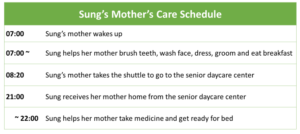
Sung said weekend care is tougher than weekday care because she needs to prepare food for every meal. The LTC-funded caregiver visits every Saturday to provide bath support, which is of great help, but Sung also needs to partake in the bathing assistance, requiring her presence.
The Cost of Caregiving
For Sung, it was an overload of work when she started supporting her parents by living together, while also having to care for her two adolescent children and working for her job at the same time. Sung said she had suffered from depression a few years ago due to the high stress of managing all her responsibilities. She had to seek psychiatric and medical treatments to overcome her depression.
Sung is considering sending her mother to the 24-hour nursing home as her health status is gradually deteriorating. She has applied for the institution for her mother’s stay, but she faces a long waiting list with more than 200 people. Sung said the reason for such a long waiting list is because this is a public nursing home, which is believed to provide better quality care and facilities.
Two years, she said, is what she thinks as the maximum number of years that she would be able to live with her mother if the current situation holds. But if it worsens, that is, if her mother’s dementia symptoms get worse, Sung will also consider sending her mother to some other facility with a shorter waiting list but also with lower quality of care.
She said that she would have to set a deadline to her caregiving for her own sake. She does not want to spend the rest of her 50s trapped with the care duty to her mother. Her children are now independent adults. Sung wants to start living her own life. She also feels she has done enough for her mother, her families and relatives all know it, and nobody will blame her for making this decision. Sung said because she is also a human, she needs to have her life and has the right to pursue it instead of sacrificing for her family.
****************************
See the surveys utilized for conducting this research below:
2018 South Korea Eldercare and Childcare Household Survey – Childcare
2018 South Korea Eldercare and Childcare Household Survey – Eldercare
Stakeholders Come Together in South Korea to Discuss Care Work & amp; Social Inclusion
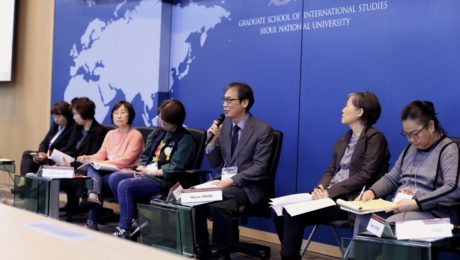
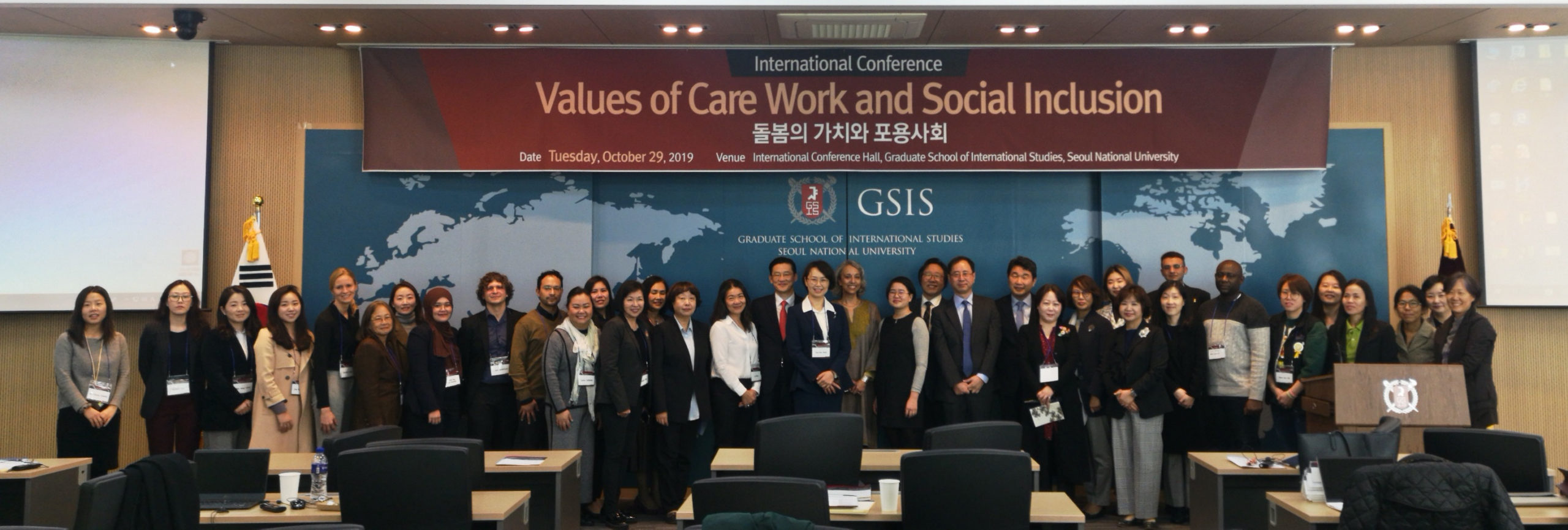
On October 29, 2019, the Care Work and the Economy Project (CWE-GAM) and its partner in South Korea the Center for Transnational Migration and Social Inclusion (CMTS), which was officially launched in August of this year under the Institute of International Affairs at SNU GSIS, hosted an international conference on “Values of Care Work and Social Inclusion.” Five other institutions joined efforts to lend generous support for this event, including Open Society Foundations and the the William and Flora Hewlett Foundation.
The conference brought together researchers and representatives from civil society organizations to share knowledge on the present state of care provisioning in South Korea, learn about the respective challenges for paid and unpaid caregivers, and discuss necessary policy changes that are grounded in recognition of the value of care work. Stories from Thailand, Malaysia, and Colombia enriched the discussion and provided better perspectives to reflect on the case of South Korea. The participants affirmed the need for enhanced cooperation between the research community and civil society so that the actual voices of care workers can be better heard in the process of policymaking.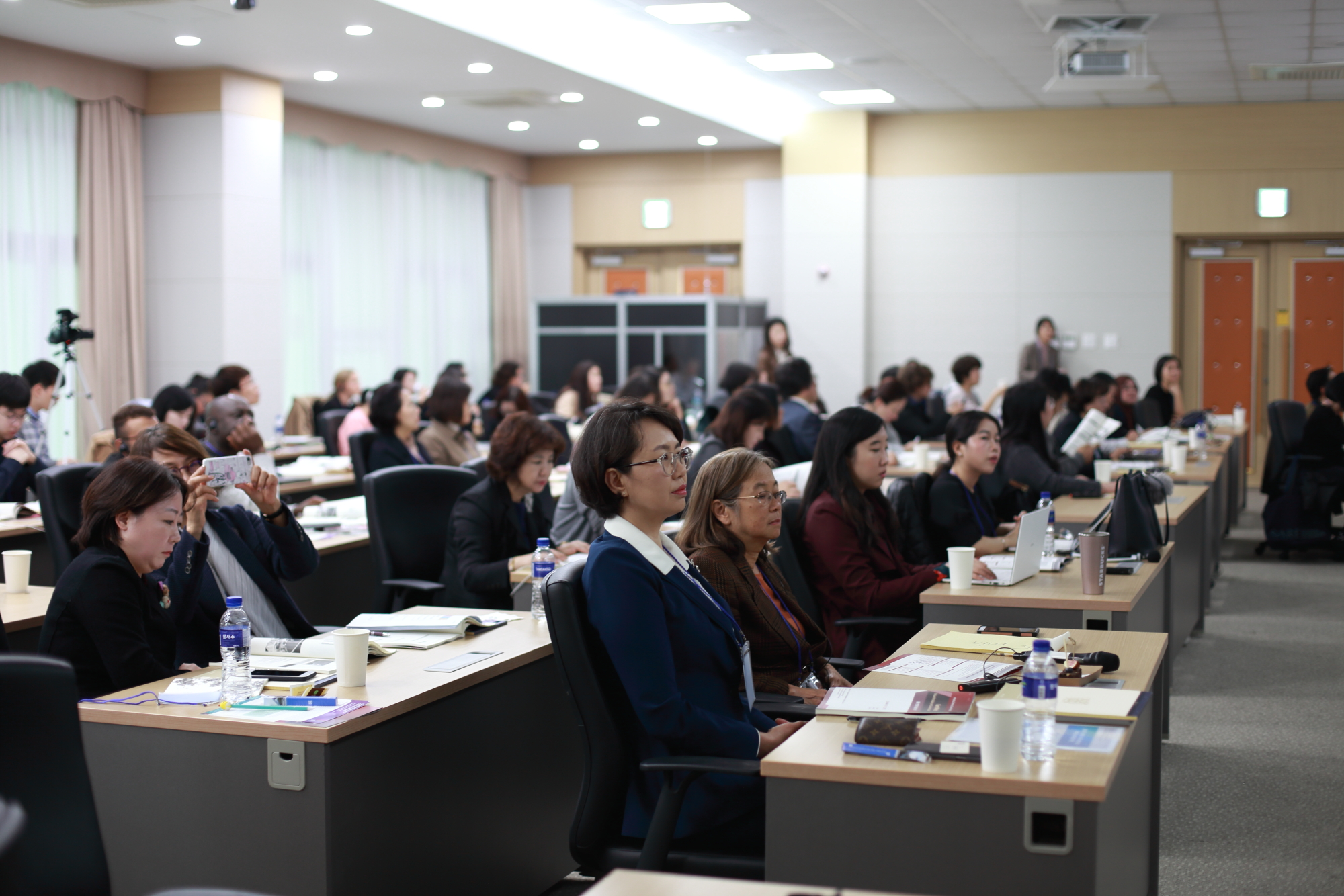
The October 29th conference was held as part of a four-day program comprising two expert workshops and two conferences, which aimed to examine the subject of care in the context of solidarity and social inclusion. The Care Work and the Economy Project (American University), lead by co-PIs Maria Floro and Elizabeth King, and CMTS, under the directorship of Ki-Soo Eun of SNU GSIS, has been conducting research with a broad network of international scholars to achieve a deeper understanding of the nature of care work through the use of innovative measures and methods, and to contribute to the development of tools for shaping relevant macroeconomic and social policies.
A Gendered Social Accounting Matrix for South Korea
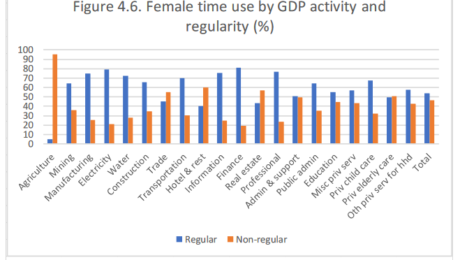
A social accounting matrix (SAM) is an economy-wide consistent representation of the payments in an economy, linking production, primary factors, and institutions (the latter often split into households, government, and the rest of the world). In the words of Round (2003), “it is a comprehensive, flexible, and dis-aggregated framework which elaborates and articulates the generation of income by activities of production and the distribution and redistribution of income between social and institutional groups.” Most of the time, a SAM refers to the economy of a country for one year. It may be used to describe the structure of an economy and as a data input to economic models, most importantly CGE models. This paper documents a gendered Social Accounting Matrix (SAM) for South Korea for 2014: the steps followed in its construction, the data sources, and what the SAM says about the economic structure of this country (for brevity from now on referred to as Korea), including gender, time use, and the role of households in providing care and other services provided by households. The SAM that is presented is the key data input to a forthcoming analysis of gender and care in Korea’s economy based on GEM Care, a computable general equilibrium (CGE) model.
At an aggregate level, the value-added in the GDP economy is roughly 86 percent of the total (with agriculture, industry, services accounting for 2, 33, and 51 percent, respectively) and the non-GDP economy 14 percent. This information may be contrasted with aggregate time shares in terms of which, the non-GDP economy accounts for a much larger share, 40 percent. If leisure also were included, then it would on its own account for 50 percent of total time, 53 percent for men and 47 percent for women. The share of time allocated to household activities are drastically different for men and women, 15 and 57 percent, respectively. For women, non-care household services comprise the largest time using activity by a wide margin, followed by household childcare, trade services, and hotel and restaurant services. For men, manufacturing dominates, followed by trade services, household non-care services, and construction. For agriculture and industry, the lesser educated dominate all activities except electricity for both men and women. For services, the differences across sectors are drastic with some dominated by those with high education and others by those with low. These are few of the many descriptive findings from the gendered SAM developed by the authors.
This paper will be available December 2019.
This blog was authored by Binderiya Byambasuren, Kijong Kim & Hans Lofgren
Glimpse of Family Caregivers’ Context: Actual time vs. Desired time for Care
Attitudes towards family care are changing. Only 27% of Koreans surveyed in 2018 agreed that the family is responsible for elderly family member care. As for population aging, the middle age group of Korean society is becoming a true “Sandwiched Generation” (supporting both unmarried children and elderly parents) due to the longevity increase among elderly parents and postponement of marriage among the young generation. In addition, caring for grandchildren by the young elderly group is becoming more prevalent as the number of employed married women has increased in recent decades. To respond to this family burden, Long Term Care Insurance for the Elderly (LTCI) has been expanded since 2008. Statistics of the LTCI program show a stiff increase in care provision for supporting the daily lives of elderly who suffer from physical and mental ailments.
Cha & Moon (2019) investigate the nature of family care in the context of expanding public care provision. Using the 2018 Family Survey for Child and Elder Care, the authors assess the role of family care and how family members take part in the changing elderly care process. Family caregivers spend, on average, about 8 hours a day providing care to elderly family members on caring days, or about 50 hours a week. However, the average preferred number of hours for care is 24 hours per week, almost half of the actual care hours. Those who are classified as mildly or severely over-caring tend to live with their elderly family member, partly because the elder family member has a severe limitation in their Activities of Daily Living (ADL) and is unlikely to spend more than 3 hours per day alone.
On the other hand, care givers whose hours matched their desired hours are relatively young and the employment rate is higher than among other types. Compared to this matched case, over-caring is more common when attentiveness is required, when the caregiver perceives the necessity to take on greater responsibility for the elderly care recipient, and when time consuming care tasks are needed to care for the elderly family member. The authors speculate that the different types of care arrangements—under-caring, matched, and over-caring—appear to represent the sequential process of elderly care, from making regular care-visits to constantly ‘being there’ next to the recipient.
This paper will be available December 2019.
Family Caregivers’ Elder Care: Understanding Their Hard Time and Care Burden
In response to the imminent aging problem in South Korea, the National Long-Term Care Insurance (NLTCI) system was introduced in 2008. The goal of the NLTCI was to give support to the families who are taking care of their elderly. The burden of family care can be grouped into four broad categories – unpaid and at home, paid and at home, paid and in facility, and unpaid visit of the family when care recipient is in facilities. Moon et al (2019) focus on the challenges faced by providers of unpaid care within families – unpaid care by family members is the most prevalent form of elderly care in Korean society.
Korean’s attitudes or thoughts on the family care responsibility of their old parents have changed surprisingly as time passed. In 1998, 89.9% of Koreans agreed with the idea that the care responsibility of their old parents belongs to the family. In 2014, the figure dropped to about a third of the population – only 34.1% of surveyed adults agreed to share the responsibility. The authors take this trend and generational gap as the departure point for their qualitative analysis of the difficulties faced by caregivers, with a view that there might be a clash or inconsistency in the care behaviors of the family members or in their ways of thinking on elderly care.
Using a combination of oral history and in-depth interviews, Moon et al (2019) shed light on the increasing burden of labor force participation and aging parents and in-laws on Korean women. Many elderly persons need attention and care continuously for 24 hours – in this regard the public care service providers provide limited relief as they work for only three hours at a time. In addition to the public-private and paid-unpaid differences in the burden of care, the authors draw attention to the difficulty of deciding who in the family takes up the responsibility. In many cases, the traditional caretaker roles fulfilled by the daughters-in-law have shifted to the daughters of the elderly. Social norms also contributed to the disproportionate caretaking burden borne by women.
- Published in South Korea, Understanding and Measuring Care
Care Arrangement and Caregiving Activities in South Korea: An analysis of 2018 Care Work Family Surveys on Childcare and Eldercare
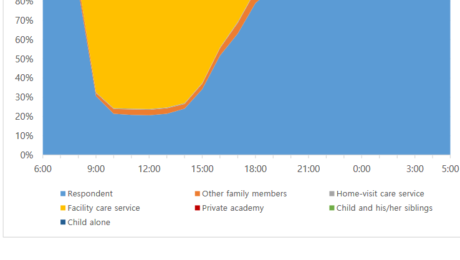
The rise of the care crisis in South Korea has evolved with Korea’s demographic shifts, increasing female work force participation, and changes in the norms and values of family and care over previous decades. Childcare and eldercare, once regarded as women’s typical role within family, are now gaining more social recognition in the public realm. Kang and Eun (2019) examine the nature of, and demand for, caregiving in various areas of the South Korean economy, including family care, care services, childcare and eldercare. The study is based on the nationally representative Care Work Family Surveys on Childcare and Eldercare.
The authors find a significant gap between the number of hours spent on childcare by mothers and fathers. A majority of respondents (women) used at least one external care service. Among caregiving activities, housework such as preparing meals, cleaning, and laundry were reported as the most difficult as well as the most frequently performed activities. Relational and physical activities such as helping to dress, wash, or play with children were reported as less difficult. Caregiving for the elderly can be more complex compared to care arrangements for children, because the range of participants in the family varies. Among all respondents, daughters-in-law were the primary caregiver in the greatest number of cases, followed by daughters, spouses, and sons. Spouses spent the highest number of hours on caregiving, followed by daughter in laws. External care services were not as common for elderly care. Home visit care and home bathing services from the National Long-Term Care program were the most commonly utilized services, although the 3-hour limit per visit amounts to a low amount of total caregiving time. Assisting with bathing and using the restroom was considered especially difficult for the elderly. Housework was performed with the same intensity and frequency in both childcare and eldercare, highlighting the important role it plays in both.
This paper will be available December 2019
This blog was authored by Eunhye Kang and Ki-Soo Eun
- Published in South Korea, Understanding and Measuring Care
Methodology for Estimating the Paid Care Sector in South Korea
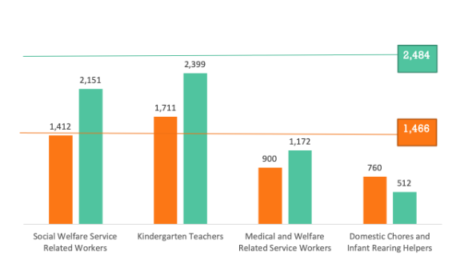
Care work, whether unpaid or paid, lies at the heart of humanitarian concern and expression, and our societies and economies are dependent on it to survive and thrive. Across the world, women account for more than three-quarters of the total amount of unpaid care time while two-thirds of paid care workers are women (Folbre et al. 2012; ILO 2018; Yoon et al. 2011).The outsized role that women play in providing care is readily observed in South Korea, with its strong patriarchal and familistic orientation that assigns primary responsibility for the care of children and elderly to women in the household, reinforcing the economic significance of gender. While unpaid care work by family members, especially women, makes up a large part of the care provided within Korean society, the rapid aging of the population and the fact that more than 50% of the female population aged 16 and older participated in the labor force in 2016-18 underscore the importance of paid care workers in meeting care needs(ILO 2018).They tend to the most basic necessities and help sustain the well-being of those in dependent positions, such as children, frail elderly, or people with illness and/or disabilities. Broadly, there is a spectrum of paid workers providing care, ranging from informal workers such as domestic service workers, nannies, and home care aides in private homes to formal workers in child care centers, nurseries and early childhood learning centers, elder care centers, nursing homes, and assisted living facilities, to nurses and teachers.
Accounting for the contribution of paid care workers is crucial to our understanding of the centrality of care in the development of human capabilities and economic progress; itis a crucial part of the effort to make women’s work and all forms of care work more visible. As the ILO (2018) points out, “care workers close the circle between unpaid care provision and paid work” (p.166). It is also critical to understand their work conditions since they represent one of 5the fastest growing segments of the labor force. For that reason, it is of particular concern that the paid care workforce experience slow wages and difficult working conditions across occupations and industries (ILO 2018). For instance, domestic workers are most vulnerable to exploitation and abuse among all workers in the labor market (UNDP 2015), a consequence of their frequent exclusion from laws and regulations affording labor protections. Understanding paid care work is therefore critical to shedding light on the implications of economic, cultural, and policy contexts that shape the larger labor market as well.
Suh (2019) provides a comprehensive picture of the paid care workforce in South Korea by measuring its size and extrapolating the median wage earnings and aggregate hours spent on care-giving by the workers using following data sources: the Local Area Labor Force Survey, Child Care Statistics, Social Services Voucher Statistics, and Long-term Care Insurance Statistical Yearbook for 2009 and 2014. The size of the paid care workforce in South Korea in this estimation focuses on the value of the labor provided by care workers that are directly and indirectly involved in elder care and childcare provision. The estimation will be used for making the paid care sector visible in the Korean Social Accounting Matrix (SAM), which serves as the base for developing the GAM Care Computable General Equilibrium (CGE) model for policy analysis.
This paper will be available December 2019
- Published in South Korea, Understanding and Measuring Care
Methodology for Estimating the Unpaid Care Sector in South Korea
Mainstream economists continue to define economic growth in terms of conventional measures such as market employment and income per capita. Women’s taking on full-time employment outside the home, therefore, has stimulated Gross Domestic Product (GDP) growth, while the social cost of a shift from informal to the formal economy has been ignored. The importance of fully recognizing the economic contributions of all forms of work –paid and unpaid–as a precondition for achieving gender equality has been proposed by feminist researchers since 1980s (Waring 1988, Folbre 1991). They have emphasized the need for empirical analysis of time devoted to unpaid care work, especially direct care of children, adults in need of assistance because of illness or disability, and the frail elderly.
Unpaid care work, i.e. household production, is the most significant part of production which is excluded from the production boundary of the system of national accounts(SNA) and hence, from the most commonly used economic indicator, Gross Domestic Product (GDP). The failure to recognize the economic value of unpaid care work leads to the belief that people who, without compensation, devote time to caring for others are unproductive or inactive and their unpaid activities fall outside the business of economic life. To be sure, unpaid household services and care work are now recognized in the landmark resolution for defining and measuring work passed during the 19th International Conference of Labour Statisticians (ICLS) in 2013. Nevertheless, the lack of recognition of unpaid care work in the national accounts hinders the promotion of gender equality at the macroeconomic level due to the importance of these accounts as instruments for policymaking.
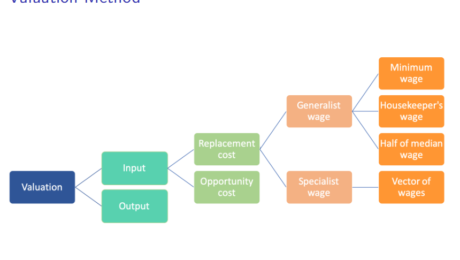
Suh (2019) first explores the concept of unpaid care work and its two forms, direct or relational care activities and indirect care activities. It then examines the role of time use data in estimating the unpaid, direct or relational care labor time provided by household members and the various methods by which this form of unpaid care work can be measured and valued, highlighting methodological and measurement issues. The input-based approach is then applied to the estimation of the imputed value of unpaid care provided by women and men aged 18 years and older based on the national Korean time use survey data and the Korean Labor Force survey for 2009and 2014. A range of wage rates is used for the estimation and differences between women and men are highlighted. These estimates are then aggregated for the population of South Korea. Finally, the paper concludes with a brief commentary on the importance of measuring and valuing unpaid care work.
This paper will be available December 2019
- Published in South Korea, Understanding and Measuring Care
An Overview of Care Policies and the Status of Care Workers in South Korea
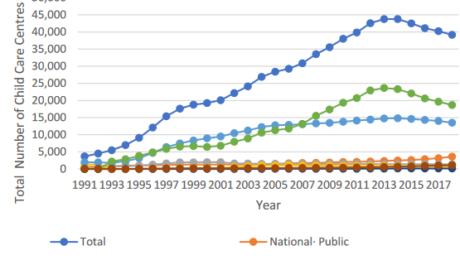
The last couple of decades have seen a dramatic transformation of the care infrastructure in South Korea. This is evident from the introductions of successive government policies and programs to socialize care and to address the issue of work-family balance. These new policies and programs have resulted in a steady expansion of publicly funded and publicly or privately provided care services for children and the elderly, financial support for families with young children, and family support programs such as maternity and parental leaves and family care leaves. Although there has been a significant amount of research on child and elder care policies in Korea, not as much attention has been paid to the status of care workers. This is unfortunate particularly given that social care expansion in Korea has been one of the most important drivers of employment growth in the country for the last decade and a half.
Peng et al (2019) provide an overview of care policies in South Korea and their developments since 2000 and discuss the status of care workers in the context of the current care infrastructure. They focus on paid childcare and elderly care as much of the country’s current care policies are directed to these two sectors. A broad overview outlines the current care policies and systems, including some data on the number of people who are affected and serviced, and some of the immediate causes of the government’s policy focus on care and of social care expansions and reforms. Recent developments in Korea’s care policies illustrate a path of progressive and successful socialization of care that has yielded a significant employment generation, particularly for women. Despite the progress in social care, however, available data suggest that the working conditions and status of care workers in Korea are not very positive: women dominate care work in both child care and elder care, and care workers are largely poorly paid, over-worked, and their employment is precarious. Care work is also accorded with low social and occupational status, and many care workers experience significant social and emotional stress.
The authors conclude by discussing the implications of South Korea’s current care infrastructure for gender equality and the care economy. To better understand the nature of care work and the status and situations of care workers, and Korea’s care infrastructure, they call for more in-depth data collection on care workers as well as more comprehensive measures of care
This paper will be available December 2019
- Published in South Korea, Understanding and Measuring Care